FAK Container Shipping: How Freight All Kinds Works in FCL and LCL
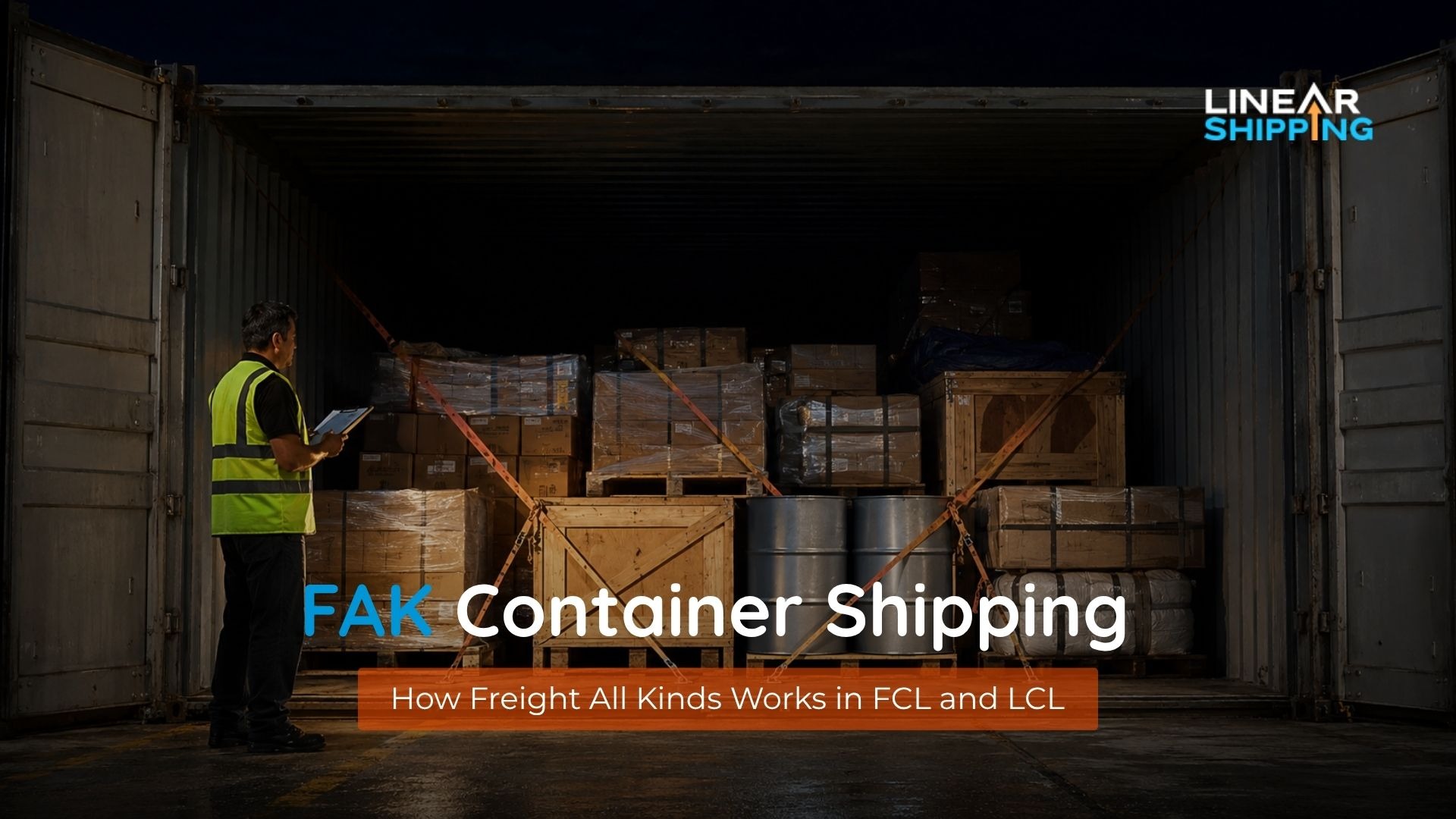
How does FAK work in FCL and LCL?
FAK, or freight all kinds, is a rate structure that charges mixed commodities a single blended rate instead of rating each one separately, and it applies to both full and shared containers. In a full container load, FCL FAK charges one flat rate for the whole box under a Master Bill of Lading. In shared consolidation, LCL FAK charges each shipper by the cubic meters they use under a House Bill of Lading. The difference is dedicated versus co-loaded, and flat-rate versus per-volume.
Freight all kinds is one of the most useful and most misunderstood ideas in ocean shipping. Shippers often assume it is simply a consolidation product for small loads, but FAK is a rate structure, not a shipping method, and the same principle can sit on top of either a full container or a shared one. Understanding both versions, FCL FAK and LCL FAK, is what lets a shipper book the structure that actually fits their volume rather than defaulting to the one they happened to hear about first.
At its core, FAK groups goods with different classifications under one unified rate, so a box of varied products is priced as a single blended shipment rather than item by item. The goods still need their correct HS codes for customs, but the freight itself is quoted as one number. This guide shows how that plays out across a full container and a consolidated one: how each is rated, documented and loaded, where the volume line sits between them, and which structure suits which shipper. Knowing exactly what qualifies as a FAK commodity is the starting point, and from there the two structures diverge in clear, practical ways.
FAK applied to a full container load (FCL FAK)
FCL FAK is what you get when a single shipper fills an entire container with a mix of different products and rates the whole box under one freight all kinds tariff. Instead of classifying and pricing each commodity in the load separately, the carrier or forwarder applies a single blended rate to the container as a unit. The shipper owns the whole box, loads it exclusively with their own varied cargo, and pays one flat container rate regardless of the commodity spread inside.
This structure suits an importer or distributor moving a full container of assorted goods, say a mix of housewares, tools and packaged products in one shipment. Without FAK, that variety would mean multiple rate classes and a complicated quote. With FCL FAK, it becomes a single, predictable number for the container, which is simpler to book, simpler to budget and simpler to reconcile. The cargo is sealed at origin and stays sealed to destination, so it carries the security and speed advantages of any full container while keeping the pricing simplicity of a blended rate.
FAK applied to shared container consolidation (LCL FAK)
LCL FAK is the version most shippers picture when they hear the term. Here the container is shared, and a consolidator combines cargo from several different shippers, each sending a mix of goods, into one box at a container freight station. The consolidator applies a freight all kinds rate across that shared container, and each shipper pays for the portion of space their cargo occupies.
This is the natural home of FAK, because a consolidated box is almost always full of unrelated commodities from unrelated shippers, and rating every item individually would be unworkable. A blended rate keeps the shared container commercially simple, which is exactly why forwarders lean on FAK for consolidation. For a shipper with a modest, mixed load that does not fill a container, LCL FAK is the route that reaches ocean markets without paying for empty space, and it is the structure behind most palletized FAK movements, where varied cartons ride together on shared pallets inside a co-loaded box.
How the rating differs between the two structures
The rate structure is where FCL FAK and LCL FAK truly separate, and it comes down to how the blended rate is measured.
FCL FAK is rated as a flat rate per container. You pay the same for the box whether it is eighty percent or one hundred percent full, so the more you load into your own container, the lower your effective cost per unit. The blended FAK rate applies to the container as a whole.
LCL FAK is rated per cubic meter, or per ton where the cargo is dense, whichever is greater. Each shipper pays only for the space their goods occupy inside the shared box, with the blended FAK rate applied to that measured volume. This is what makes LCL FAK economical for small loads and FCL FAK economical for large ones. In both cases the point of FAK is the same, a single blended rate instead of commodity-by-commodity classification, and seeing the difference between FAK and commodity freight rating makes clear why shippers with varied goods reach for a blended rate in the first place.
Documentation: Master Bill for FCL FAK, House Bill for LCL FAK
The two structures produce different bills of lading, and the distinction matters for both control and customs.
With FCL FAK, the container is a single consignment, so it typically moves under one Master Bill of Lading issued by the carrier directly to the shipper, or a single house document where an intermediary is involved. One box, one bill, straightforward clearance.
With LCL FAK, the shared container carries multiple consignments, so it needs two layers. The carrier issues one Master Bill of Lading to the consolidator for the whole box, and the consolidator issues a separate House Bill of Lading to each individual shipper for their portion of the cargo. Every shipper in the container holds their own House Bill, which is the document they present to their bank and use for their own clearance. The heavier documentation is the trade-off for sharing the box, and it is coordinated by the consolidator rather than the individual shipper.
Volume thresholds where FCL FAK becomes available
The choice between the two structures is driven mostly by volume, and there is a rough break point where a full container starts to win. As a planning rule, cargo under roughly 13 to 15 cubic meters usually ships more cheaply as LCL FAK, because you pay only for the space you use. Once a load approaches or passes that mid-teens range in a 20-foot container, or the mid-twenties in a 40-foot container, the flat FCL rate often matches or beats the accumulated per-cubic-meter LCL charges, and FCL FAK becomes the better structure.
Why the break point exists. LCL is charged per cubic meter and also carries container freight station handling on each end, so as your volume climbs, those per-unit charges stack up. A full container is a single flat rate, so beyond a certain fill level the whole box simply costs less than paying for the same space slice by slice. The exact line shifts with the lane, the season and destination charges, so a live quote on both structures is worth running when your volume sits near the middle.
Container loading: dedicated versus co-loaded
The physical handling of the two structures is as different as the pricing. FCL FAK is a dedicated load. The shipper's mixed cargo is loaded into a container that holds nothing else, the box is sealed at origin, and it stays sealed until it reaches the destination, with no intermediate handling. That means fewer touch points, lower handling risk and a faster, more direct routing.
LCL FAK is co-loaded. The cargo is delivered to a container freight station, measured, and stuffed into a shared box alongside other shippers' goods, then deconsolidated and separated at the destination station before release. Those extra consolidation and deconsolidation steps add handling points and a little transit time, which is the practical cost of sharing a container. Neither approach is better in the abstract, they simply match different volumes, and the loading method follows directly from whether you are filling your own box or sharing one.
Which structure fits which shipper profile
Matching the structure to the shipper is usually straightforward once the volume is known.
- FCL FAK fits importers, distributors and manufacturers who move a full container of varied products at a time, want the security of a sealed box, and prefer a single flat rate for a mixed load.
- LCL FAK fits smaller or growing shippers with mixed goods below a container, irregular volumes, or a need to ship frequently in modest quantities without waiting to fill a box.
Many shippers use both over time, running core volume as FCL FAK while sending smaller or urgent mixed loads as LCL FAK, and the broader FAK and LCL relationship shows why the two are complementary rather than competing. Structured FAK consolidation lets a shipper move between the two as their volume changes without relearning the process each time.
When FAK is not the right fit
FAK is powerful, but it has boundaries worth knowing before you assume it applies. It is used for standard dry cargo, so refrigerated, hazardous and oversized or out-of-gauge goods fall outside it and need their own classification and handling, whether the shipment is full or shared. FAK is also less advantageous for a single homogeneous commodity, because a load that is all one product can sometimes be rated more cheaply under its own specific classification than under a blended one. The structure earns its value on mixed, standard dry loads, which is exactly where the classification workload it removes is heaviest, so it is worth confirming your commodities qualify before booking either FCL FAK or LCL FAK.
FCL FAK versus LCL FAK at a glance
| Factor | FCL FAK | LCL FAK |
|---|---|---|
| Container | Dedicated to one shipper | Shared with other shippers |
| Rating basis | Flat rate per container | Per cubic meter, or per ton if denser |
| Bill of lading | One Master Bill for the box | House Bill per shipper, Master Bill to the consolidator |
| Loading | Dedicated, sealed origin to destination | Co-loaded at a freight station, deconsolidated at destination |
| Handling points | Fewer, lower risk | More, with consolidation and deconsolidation |
| Best volume | Roughly a full container, mid-teens CBM and up | Below roughly 13 to 15 CBM |
| Best for | Full mixed loads wanting flat pricing and security | Small or irregular mixed loads paying only for space used |
Frequently asked questions
Can FAK rates apply to a full container load?
Yes. FAK is a rate structure, not a shipping method, so it applies to a full container load as well as to shared consolidation. In an FCL FAK shipment, a single shipper fills a container with a mix of different products and the whole box is charged one blended freight all kinds rate rather than each commodity being rated separately.
What is the difference between FCL FAK and LCL FAK?
FCL FAK is a full container dedicated to one shipper's mixed cargo, charged as a flat rate for the box and documented under a single Master Bill of Lading. LCL FAK is a shared container consolidating several shippers' mixed cargo, charged per cubic meter with each shipper receiving a House Bill of Lading. The difference is dedicated versus co-loaded and flat-rate versus per-volume.
Do I need a minimum volume for an FCL FAK rate?
There is no fixed minimum, but FCL FAK only makes economic sense once your volume approaches a full container. As a rough planning rule, cargo under about 13 to 15 cubic meters usually ships more cheaply as LCL FAK, while volumes in the mid-teens and above in a 20-foot container, or the mid-twenties in a 40-foot container, tend to favor the flat FCL FAK rate.
How is a FAK container documented?
An FCL FAK container moves under a single Master Bill of Lading for the whole box, since it is one consignment. An LCL FAK container needs two layers: the carrier issues one Master Bill of Lading to the consolidator for the container, and the consolidator issues a separate House Bill of Lading to each shipper for their portion. Every commodity still needs its correct HS codes for customs.