FAK vs LCL Shipping: What Is the Difference and When to Use Each
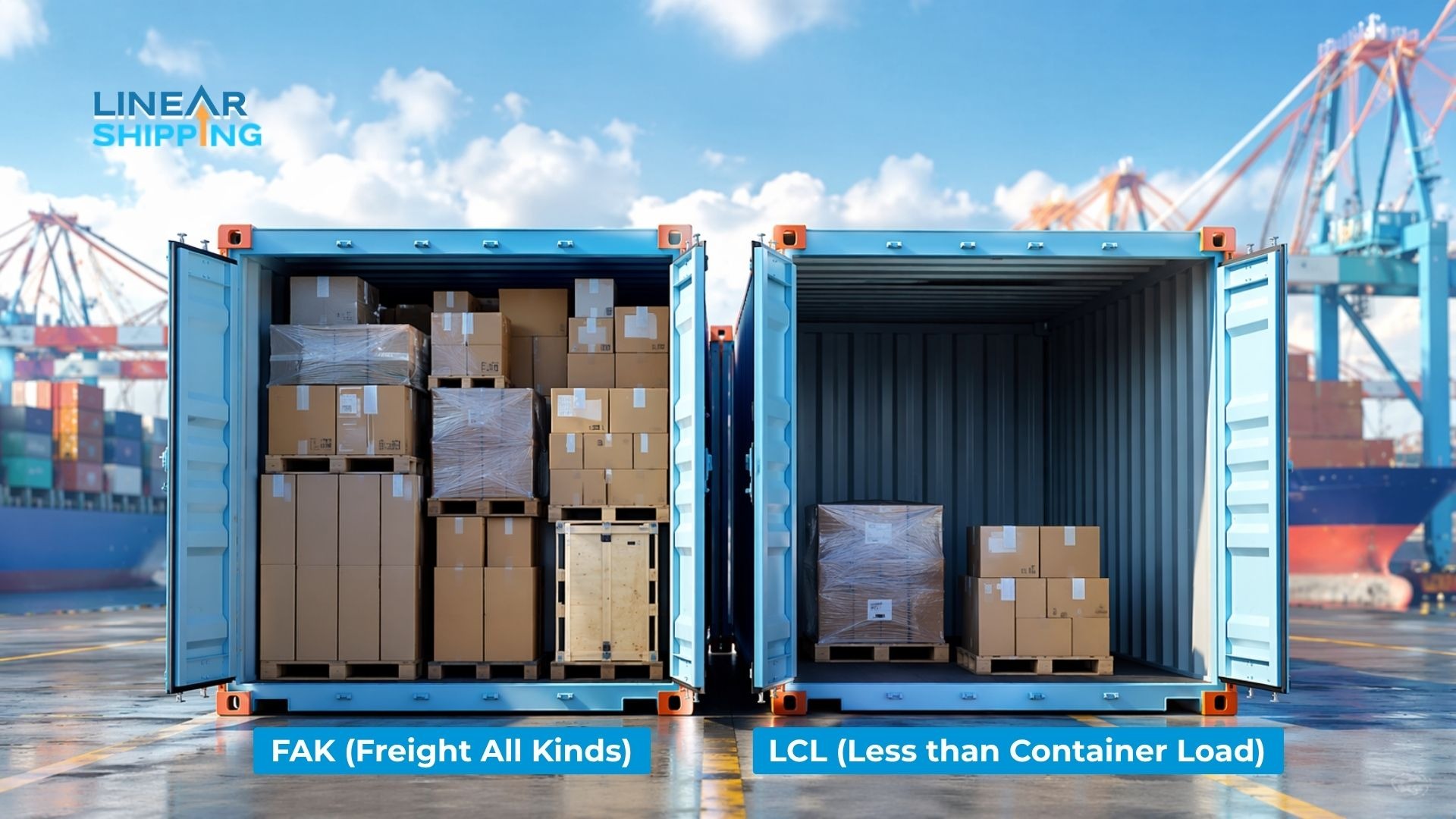
FAK (Freight All Kinds) and LCL (Less than Container Load) are not the same thing. LCL is a shipping method: your cargo shares a container with other shippers because you do not have enough volume to fill a full container. FAK is a pricing structure: one blended freight rate is applied regardless of the exact product mix in the container. Most LCL shipments move under FAK pricing, but FAK also applies to full containers with mixed cargo. So the real decision is two-part: container fill (LCL vs FCL) and rate structure (FAK vs commodity-specific).
If you have been quoting international shipments, working with freight forwarders, or reading carrier tariff sheets, you have almost certainly seen both terms: FAK and LCL. They appear in similar contexts and are often presented as alternatives. They should not be. FAK and LCL describe different things. One is a method of moving cargo; the other is a method of pricing it.
1. Why FAK and LCL Are Confused — and Why It Matters
Most LCL shipments in ocean freight move under FAK pricing, so shippers repeatedly seeing "commodity: FAK" on LCL quotes often conclude they are identical. They are not. This misunderstanding leads to poor decisions in quote comparison, routing strategy, and cost forecasting.
2. What LCL Shipping Actually Is
LCL (Less than Container Load) means multiple shippers share container space. Cargo is received at an origin CFS, consolidated, shipped, then deconsolidated at destination CFS for release to each consignee.
- LCL determines: how the container is physically filled.
- LCL does not determine: whether freight is priced as FAK or commodity-specific.
Linear Shipping supports LCL consolidation from Houston, Savannah, New York, and Los Angeles across trade lanes to the Middle East, West Africa, and Central America.
3. What FAK Is — Precisely
FAK (Freight All Kinds) is a rate classification. It applies one blended rate to qualifying mixed cargo instead of pricing each SKU by its own commodity tariff.
- FAK determines: how the container is priced.
- FAK does not determine: whether the shipment is LCL or FCL.
For a deeper breakdown, see the FAK commodity guide.
4. How FAK and LCL Relate to Each Other
Think of two axes:
- Container fill: LCL or FCL
- Rate structure: FAK or commodity-specific
That creates four valid combinations: LCL+FAK, LCL+commodity-specific, FCL+FAK, and FCL+commodity-specific.
5. FAK vs LCL: The Key Differences Across Every Dimension
| Dimension | LCL | FAK |
|---|---|---|
| What it is | Shipping method | Rate pricing structure |
| Container fill | Shared container | Can be LCL or FCL |
| Documentation style | House BL by shipper | FAK shown as rate designation |
| HS code requirement | Required | Required |
| Best for | Sub-container volumes | Diverse product mixes |
6. When LCL Is the Right Choice
- Cargo is below typical FCL breakeven (often around 15-20 CBM by lane).
- You ship often but in small batches.
- Cargo is suitable for co-loading in CFS consolidation.
- Destination lane has reliable LCL schedules.
7. When FAK as a Full Container Strategy Is the Right Choice
- You fill full containers with changing SKU mixes.
- You move regular monthly volumes.
- You want predictable pricing vs constant commodity re-quotes.
- You are working with an NVOCC that holds active FAK carrier agreements.
8. Documentation: How FAK and LCL Differ on Paper
LCL typically uses House Bills of Lading for each shipper under a shared Master Bill. FCL FAK usually uses one booking controlled by one shipper. In both cases, HS/Schedule B classification, AES/EEI obligations, and accurate cargo descriptions still apply.
9. Which Cargo Types Work Best Under Each Approach
Best for LCL: palletized consumer goods, spare parts, mixed commercial cartons, and small recurring exports.
Best for FAK FCL: full containers with varied products and stable monthly shipping programs.
Not standard LCL/FAK: IMDG hazmat, reefer cargo, high-value cargo beyond liability limits, scrap/bulk waste, and auto-program cargo.
10. How Linear Shipping Handles Both
Linear Shipping is an FMC-licensed NVOCC and freight forwarder. We run LCL consolidations and FAK FCL programs from Houston, Savannah, New York, and Los Angeles, with established agreements on active Middle East, West Africa, and Central America lanes. We manage AES/EEI filing, BL issuance, invoice/packing list validation, and destination coordination under one workflow.
To evaluate your profile and lane fit, contact us through the contact page.
Frequently Asked Questions
Is FAK the same as LCL?
No. LCL is a container-sharing shipping method. FAK is a pricing structure.
When is LCL cheaper than FCL?
Usually when volume is below roughly 15 to 20 CBM, depending on lane and market.
Do I still need HS codes for an FAK shipment?
Yes. FAK does not replace customs/export classification requirements.
Can hazardous goods move under FAK or LCL?
Not under standard FAK/LCL programs. IMDG cargo needs specialized handling and rating.
What is a House Bill of Lading and when does it apply?
In LCL, the House BL is issued per shipper for their share of a consolidated container.
Which is better for shipping to the Middle East — LCL or FAK?
It depends on volume: lower volume favors LCL; full mixed containers often favor FAK FCL.
What is a Container Freight Station (CFS)?
A CFS is where LCL cargo is consolidated at origin and deconsolidated at destination.
Linear Shipping is an FMC-licensed NVOCC and international freight forwarder. We operate LCL consolidations and FAK FCL programs from warehouses in Houston, Savannah, New York, and Los Angeles, with established carrier agreements on trade lanes serving the Middle East, West Africa, and Central America. Our team manages the full documentation chain for both LCL and FAK FCL shipments, from AES/EEI filing through Bill of Lading issuance and destination coordination.