What Is FAK Commodity in Shipping? Definition, Examples & When It Applies
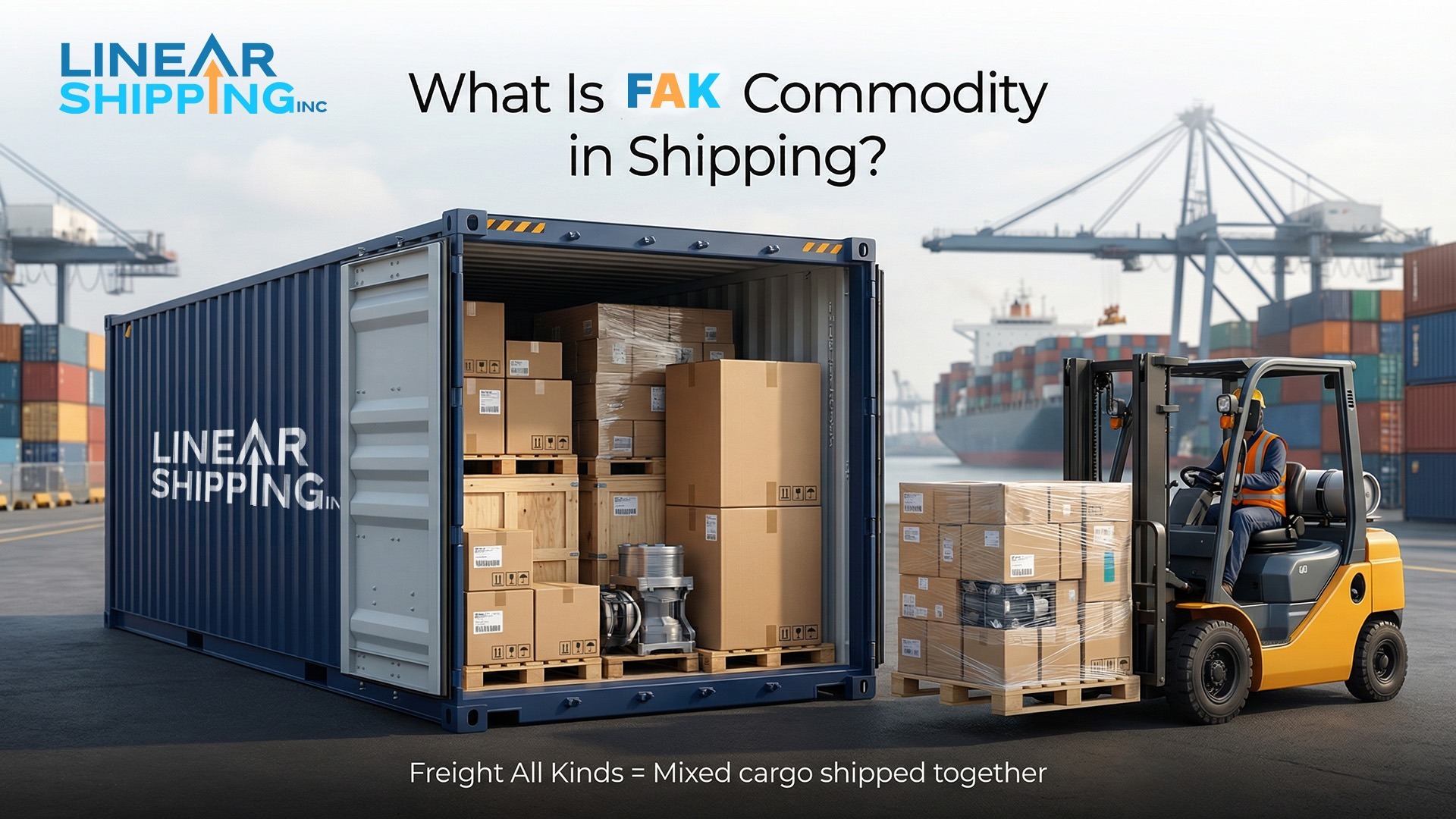
FAK commodity in shipping refers to cargo classified under a Freight All Kinds (FAK) rate, where a carrier applies one unified freight rate to an entire container regardless of the different product types inside it. The term "FAK commodity" describes a shipment where the cargo mix is treated as a single commodity category for billing purposes, rather than being broken down by individual Harmonized System (HS) codes. FAK commodity classification is most commonly used in LCL consolidation and mixed container loads, and it applies only to general, non-hazardous, dry cargo that falls within the approved scope of the FAK agreement.
The term "FAK commodity" appears frequently in carrier tariff sheets, freight quotes, and consolidation agreements, yet it remains one of the more misunderstood concepts in international shipping. Shippers see it listed on invoices, forwarders reference it in negotiations with carriers, and logistics managers sometimes use it interchangeably with terms like LCL or general cargo, when in fact it carries a specific commercial meaning that directly affects how your shipment is rated, documented, and handled.
If you have seen "commodity: FAK" on a shipping quote and wondered exactly what that means and whether it applies to your cargo, this guide provides the precise definition and practical context you need.
1. What "FAK Commodity" Actually Means in Ocean Freight
"FAK commodity" is the classification applied to cargo that is shipped under a Freight All Kinds rate agreement. The phrase functions as a cargo descriptor on a Bill of Lading or freight quote, indicating that the contents of the container are not being individually classified by product type or HS code for rating purposes. Instead, the carrier assigns a single blended rate to the entire container based on the FAK agreement terms.
The word "commodity" in this context does not refer to a raw material or exchange-traded good in the economic sense. In ocean freight, "commodity" simply means the type of cargo being shipped. When a carrier or NVOCC writes "commodity: FAK" on a document, it means the cargo type is being declared as a mixed general freight load under the FAK pricing structure, rather than being itemized by specific product categories.
This matters because ocean freight rates are fundamentally commodity-dependent. Carriers use commodity classifications to assess how much liability they are taking on, how much space the cargo occupies, what special handling it requires, and what tariff applies. FAK commodity classification bypasses that per-item analysis by grouping all the cargo under a single approved rate, provided the contents fall within the allowable scope.
Linear Shipping operates as an FMC-licensed NVOCC and has established FAK agreements with ocean carriers on major trade lanes from the United States to the Middle East, West Africa, and Central America. These agreements define the commodity scope, rate tiers, and exclusion lists that govern what can move under FAK classification on each trade lane.
2. How FAK Commodity Classification Works
Understanding how FAK commodity classification functions in practice requires looking at how ocean freight pricing works without it.
Under standard commodity-specific pricing, a carrier assesses each product category in a shipment and applies the tariff rate that corresponds to that product's HS code, density, value, and handling risk. A container loaded with electronics, spare machine parts, and household goods would theoretically attract three different commodity rates, three separate line items, and three distinct documentation requirements.
FAK commodity classification collapses that structure. The forwarder or shipper negotiates a FAK rate with the carrier that covers a defined range of general cargo. When a shipment falls within that range, the carrier applies the single negotiated rate to the entire container, regardless of what the individual items are. The documentation declares the cargo as "FAK commodity" rather than listing each product line at a separate rate.
From a carrier's perspective, this is an efficient booking: they know the box is full of general dry cargo, they apply their established rate, and they do not need to assess individual commodity risk for each SKU. From a shipper's perspective, the benefit is consistent, predictable billing regardless of which products are in the container on any given week.
The FAK commodity rate is agreed in advance as part of a contract negotiation, typically tied to a minimum volume commitment on a defined trade lane. Carriers reserve their best FAK tiers for shippers or forwarders moving consistent monthly container volumes, because reliable volume is the foundation of the FAK model.
3. What Cargo Qualifies as FAK Commodity
Not all cargo can be classified as a FAK commodity. The term applies specifically to general, non-hazardous, dry goods that fall within the approved commodity scope of a given FAK agreement. While the exact scope varies by carrier and trade lane, the following categories are typically accepted under FAK commodity classification:
- Commercial and consumer goods. Electronics components, household appliances, clothing and textiles, furniture and home goods, personal care products, sporting equipment, and similar finished goods. These are the most common contents of FAK commodity shipments.
- Industrial and machinery parts. Non-hazardous machinery components, tools, construction materials, spare parts for industrial equipment, and similar items that do not require special handling or hazmat documentation.
- Packaged food and beverages. Non-perishable food products in standard packaging, provided they do not require refrigeration or temperature control and are not subject to specific agricultural import restrictions at the destination.
- Mixed palletized general cargo. Consolidated loads from multiple shippers, often moving as LCL (less than container load), where each pallet may contain different product categories, but the overall shipment qualifies as general dry cargo.
The defining characteristic of FAK commodity cargo is that it is general enough to move without special carrier approvals, does not pose unusual liability risks, and does not require conditions outside a standard dry container environment.
For exporters shipping mixed commercial goods from the United States, particularly in smaller volumes that do not fill a full container, FAK commodity classification through an experienced freight forwarder provides access to established carrier rates without the complexity of negotiating individual commodity tariffs. Linear Shipping's FAK consolidation service is built specifically for shippers moving this type of mixed general cargo repeatedly.
4. What Is Excluded from FAK Commodity Classification
The scope of what qualifies as a FAK commodity has firm limits. Cargo that falls outside the FAK commodity scope must be declared and rated separately under commodity-specific terms. Loading excluded cargo under a FAK declaration is a misdeclaration, which carriers treat seriously and which can result in re-rating, cargo holds, or financial penalties.
- Hazardous materials. Any cargo classified under IMDG (International Maritime Dangerous Goods) regulations requires specific commodity declarations, hazmat documentation, and commodity-specific freight rates. Hazardous materials cannot move under FAK commodity classification.
- Perishable goods requiring refrigeration. Temperature-controlled cargo moves in reefer containers under specific reefer commodity rates. Perishables fall outside FAK commodity scope regardless of whether the goods themselves are otherwise general.
- High-value cargo above the FAK liability cap. Most FAK agreements include a per-package or per-container liability ceiling. Cargo with a declared value that exceeds the FAK liability limit must be declared separately and may require additional insurance or specific commodity terms. Luxury goods, jewelry, and other high-value items typically cannot move under standard FAK commodity classification.
- Scrap materials and waste. Scrap metal, waste paper, and similar bulk waste materials are typically excluded from FAK commodity agreements because they attract specific low-tariff commodity rates that are lower than the FAK blended rate. Applying FAK to scrap would actually increase the shipper's freight cost compared to the commodity-specific tariff.
- Out-of-gauge or oversized cargo. FAK commodity classification applies to cargo moving in standard 20-foot and 40-foot containers. Cargo requiring flat racks, open tops, or other special equipment is rated under separate equipment and commodity-specific terms.
- Vehicles and automotive cargo. Used vehicles and automotive parts that move under specialized auto export programs or RoRo arrangements are rated outside standard FAK commodity classification. Vehicle exports from the United States are governed by specific export compliance requirements and carrier vehicle rate structures.
Understanding these exclusions before booking prevents the most costly mistake in FAK commodity shipping: declaring excluded cargo as FAK and facing re-rating or carrier penalties after the shipment is already at sea.
5. Real-World Examples of FAK Commodity Shipments
Seeing FAK commodity classification in context clarifies when and why it applies.
Example 1: The mixed retail exporter. A U.S.-based trading company ships monthly containers to a distributor in Jeddah, Saudi Arabia. Each container includes clothing, household accessories, electronics components, and personal care items. The product mix changes slightly each month based on purchase orders. Rather than obtaining separate commodity rates for each product category and renegotiating every time the mix shifts, the company's freight forwarder books the entire container under a FAK commodity rate. Every product in the container is declared as a FAK commodity, and a single rate applies to the full container.
Example 2: The LCL consolidator. A small exporter ships two pallets of machine parts and one pallet of packaged consumer goods to a buyer in Lagos, Nigeria. The shipment does not fill a full container, so it is consolidated with cargo from other shippers at the freight forwarder's warehouse into a shared 40-foot container. The container moves under a FAK commodity classification that covers all the consolidated cargo from multiple shippers. Each shipper's portion of the container is billed based on their share of the FAK commodity rate.
Example 3: The industrial equipment distributor. A company exports industrial tools, spare parts, and maintenance supplies to a client in Dubai. The cargo is entirely non-hazardous, moves in standard dry containers, and the product mix varies by order. Using an established FAK commodity rate through their freight forwarder, they book each shipment without renegotiating rates each time a new product is added to the export catalog.
In each of these cases, what makes the shipment "FAK commodity" is not a single product type but the carrier's agreed treatment of the entire cargo load as a qualifying mix of general freight under a negotiated rate structure.
The difference between FAK and specific commodity rates explains how these two pricing models compare across cost, documentation, and operational flexibility for different cargo profiles.
6. FAK Commodity vs Specific Commodity Rates: The Core Difference
The distinction between FAK commodity and specific commodity rates is the most practical thing to understand about FAK classification in ocean freight.
A specific commodity rate is tied to a particular product as defined by its HS code. The carrier looks at what the product is, assesses its density, value, handling risk, and market tariff, and assigns a rate based on those characteristics. That rate applies only to that specific commodity. If the shipment contains a different product, a different rate applies.
A FAK commodity rate is not tied to any particular product. It is tied to the container, provided the contents fall within the approved general cargo scope. The same rate applies whether the container holds textiles, machine parts, or household goods, as long as none of the contents are excluded categories.
The practical result is that FAK commodity rates provide billing simplicity at the cost of rate optimization at the SKU level. A shipper with a stable, high-volume flow of a single low-value bulk commodity would likely find a specific commodity rate more favorable than FAK. A shipper with a diverse, changing product mix benefits from FAK because the alternative would require constant re-quoting for every new product added to their export program.
This trade-off is covered in full detail in the context of how different shipping structures work across mixed cargo operations in the guide to general cargo, FAK, and project cargo for Middle East exporters.
7. How HS Codes Interact with FAK Commodity Classification
A common point of confusion: if FAK commodity classification means the carrier does not rate each product separately, does that mean HS codes are irrelevant for FAK shipments?
The answer is no. HS codes remain required on export documentation even for FAK commodity shipments.
The FAK commodity rate governs how the ocean carrier prices the shipment. It does not affect the legal export compliance requirements that apply to the cargo. Every product in a FAK commodity shipment must still have an accurate HS code classification for:
- U.S. export documentation. AES/EEI filing requires accurate Schedule B commodity codes for every product being exported. This is a CBP requirement that exists independent of how the carrier prices the freight. Incorrect Schedule B codes on AES filings expose exporters to penalties regardless of whether the cargo is moving under FAK or commodity-specific rates.
- Destination customs clearance. The consignee's customs broker at the destination port files an import declaration that requires HS code classification for every product in the container. Customs duties are assessed based on product classification, not on how the ocean carrier rated the freight.
- Carrier Bill of Lading compliance. While the commercial rate on the Bill of Lading may reflect a FAK commodity designation, the cargo description section must accurately represent the contents. Declaring "FAK commodity" in the rate field while accurately describing the cargo in the cargo description field is correct practice. Declaring the cargo description itself as simply "FAK commodity" without a product description can create problems at customs.
The key distinction is that "FAK commodity" is a rate classification, not a cargo description. The rate can be FAK while the cargo description on the same document accurately lists what is actually in the container.
This is one of the areas where an experienced freight forwarder adds material value: structuring the Bill of Lading correctly so the FAK rate is applied while the documentation remains fully compliant with both U.S. export requirements and destination customs expectations.
8. When FAK Commodity Classification Applies to Your Shipment
Given the above, FAK commodity classification applies to your shipment when the following conditions are met:
- Your cargo is general, non-hazardous, dry goods. If everything in your container falls within the standard general cargo categories that do not require special handling, temperature control, or hazmat documentation, FAK commodity classification is likely applicable.
- Your freight forwarder or NVOCC has an active FAK agreement on your trade lane. FAK rates are not available on every route or with every carrier. They exist as negotiated agreements between carriers and high-volume shippers or NVOCCs. Accessing FAK commodity rates requires a forwarder with established carrier relationships on the specific trade lane you are using.
- Your cargo mix changes frequently or includes multiple product types. If your shipments consistently contain multiple product categories that would otherwise require separate commodity ratings, FAK classification eliminates the administrative burden of re-quoting for every variation.
- Your shipment volume is consistent enough to qualify. FAK tiers are based on volume commitments. Shippers sending consistent monthly container volumes are in the best position to access FAK commodity rates through their freight forwarder.
- You are not shipping a single bulk commodity that has a lower specific rate. If your entire container is a single low-value product that has a dedicated commodity rate below the FAK average, specific commodity pricing is likely more cost-effective.
For businesses shipping regular mixed commercial or industrial cargo from the United States, FAK commodity classification through an experienced NVOCC is typically the most practical and efficient approach. Linear Shipping works with shippers to evaluate whether their cargo profile qualifies for FAK commodity treatment on their active trade lanes and structures bookings accordingly.
9. How Linear Shipping Manages FAK Commodity Shipments
Linear Shipping is an FMC-licensed NVOCC and international freight forwarder with established FAK carrier agreements on trade lanes from U.S. ports to the Middle East, West Africa, and Central America.
For shippers with mixed cargo profiles, we manage the FAK commodity process across the full export chain:
- Commodity scope review. Before the first booking, we assess your product catalog against our active FAK agreements to confirm which items qualify and identify any products that require separate commodity-specific handling.
- Documentation structuring. We ensure that FAK commodity rate classification on the Bill of Lading is paired with accurate cargo descriptions and AES/EEI filing, keeping the shipment compliant with both carrier terms and U.S. export regulations.
- Consolidation management for LCL. For shippers who do not fill a full container, we consolidate cargo at our warehouses in Houston, Savannah, New York, and Los Angeles and move it under our established FAK commodity rates through our NVOCC carrier agreements.
- FCL FAK commodity booking. For shippers moving full container loads of mixed general cargo, we book under our FCL FAK agreements and manage the entire process from pickup through port departure.
To discuss whether your cargo qualifies for FAK commodity classification and to receive an itemized freight quote, reach out to the Linear Shipping team. Our FAK service page lists the categories we handle and the trade lanes we serve.
Frequently Asked Questions
What does "commodity: FAK" mean on a shipping document?
When a shipping document lists "commodity: FAK," it means the cargo is being rated under a Freight All Kinds classification. The carrier is applying a single negotiated rate to the entire container regardless of the different product types inside, rather than pricing each product separately by its individual commodity classification. This is a rate designation, not a cargo description, and accurate product descriptions must still appear elsewhere on the document.
Is FAK commodity classification the same as LCL shipping?
They are related but not the same. FAK commodity classification refers to how the freight rate is determined, while LCL (Less than Container Load) refers to how the shipment fills the container. LCL shipments frequently move under FAK commodity rates because consolidators combine cargo from multiple shippers under a single FAK agreement. But FAK commodity classification also applies to full container loads where the contents are diverse enough to benefit from a single blended rate rather than per-commodity pricing.
What is the difference between FAK commodity and a specific commodity rate?
A specific commodity rate is tied to a defined product type based on its HS code, density, value, and handling requirements. A FAK commodity rate is not tied to any specific product. It applies to the container as a whole, provided the contents fall within the approved general cargo scope of the FAK agreement. Specific commodity rates are typically more favorable for high-volume, single-product shipments of low-value goods. FAK commodity rates benefit shippers with diverse, changing product mixes.
Can I declare all cargo as FAK commodity regardless of what it is?
No. FAK commodity classification has a defined scope of qualifying cargo. Hazardous materials, perishables, high-value goods exceeding the FAK liability cap, scrap materials, and vehicles cannot be declared under FAK commodity classification. Loading excluded cargo under a FAK declaration is a misdeclaration that can result in re-rating, cargo holds, or carrier penalties.
Does FAK commodity classification affect U.S. export compliance?
FAK commodity classification governs how the carrier prices the ocean freight. It does not replace U.S. export compliance requirements. Every product in a FAK commodity shipment still requires accurate Schedule B classification for AES/EEI filing, correct cargo descriptions on the Bill of Lading, and standard export documentation. FAK is a pricing mechanism, not an exemption from export compliance.
Which cargo types does Linear Shipping accept under FAK commodity classification?
Linear Shipping accepts commercial goods, consumer products, industrial parts, machinery components, packaged non-perishable food products, and other non-hazardous general dry cargo under FAK commodity classification on active trade lanes. Hazardous materials, temperature-controlled cargo, high-value goods, scrap materials, and vehicles are handled under separate arrangements. The FAK service page lists the categories we handle and the trade lanes we serve.
Linear Shipping is an FMC-licensed NVOCC and international freight forwarder based in Houston, TX. Our FAK commodity programs serve exporters and importers shipping mixed general cargo from the United States to the Middle East, West Africa, and Central America. We manage commodity scope review, documentation structuring, LCL consolidation, and FCL FAK bookings as a complete service, removing the administrative complexity of mixed cargo shipping from your operation.
Linear Shipping Content Team
Linear Shipping Content Team
Linear Shipping is an FMC-licensed NVOCC and international freight forwarder based in Houston, TX. We operate FAK consolidation programs on major trade lanes from the United States to the Middle East, West Africa, and Central America, with warehouses in Houston, Savannah, New York, and Los Angeles.