How to Ship Commercial Goods from USA to West Africa: Nigeria, Ghana and Benin
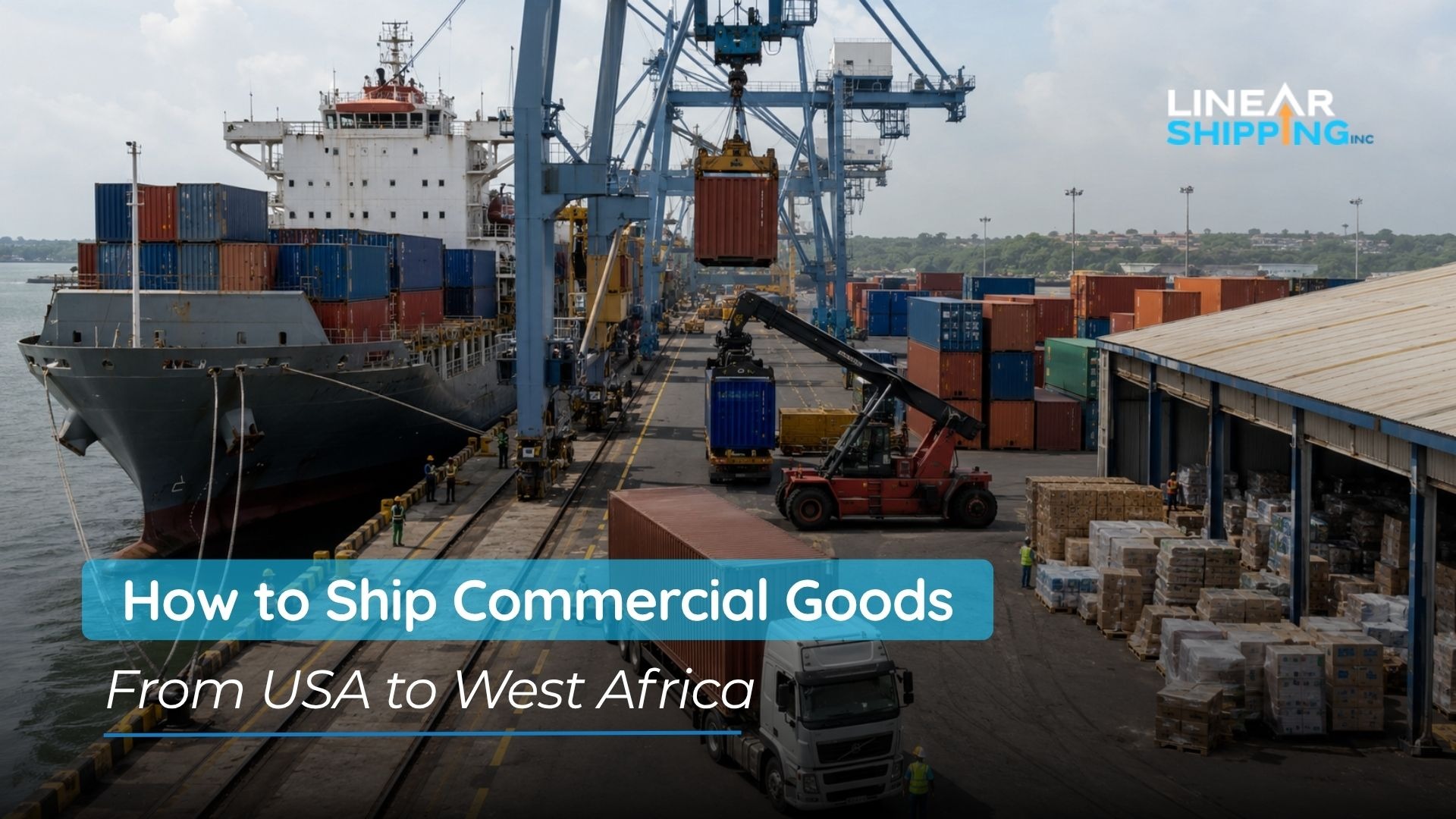
To ship commercial cargo from the USA to West Africa, choose LCL for small shipments, FAK for mixed pallets or FCL for full loads, file Electronic Export Information through the Automated Export System, and book ocean freight to Lagos, Tema or Cotonou. Benin-routed cargo needs a validated ECTN before the vessel arrives, and a destination customs broker clears the goods against the commercial invoice and documents.
West Africa is one of the most active commercial trade corridors in the world, connecting American exporters to a fast-growing consumer base across Nigeria, Ghana, Benin and their landlocked neighbors. Most of the freight guidance on this lane focuses on cars, but a large share of the real trade is general commercial cargo: electronics, textiles, machinery, building materials, packaged goods, spare parts and industrial supplies moving by container into the region's main ports. That commercial layer has its own modes, its own paperwork and its own delays, and getting them right is what keeps a shipment moving instead of sitting at the quay.
This guide covers the West Africa lane for commercial shippers end to end: how the trade corridor works, which port suits which cargo, how to choose between LCL, FAK and FCL, the ECTN requirement that catches first-time shippers, the documentation set, the delays experienced forwarders plan around, and how a shipment is staged and moved from the US. While much of the existing West Africa conversation centers on moving vehicles to West Africa, commercial cargo follows a parallel path that rewards the same discipline.
The USA to West Africa commercial trade lane
The corridor links US exporters to a regional market of several hundred million consumers, with Nigeria as the largest single economy, Ghana as a stable and increasingly efficient trade hub, and Benin serving as a coastal gateway to the landlocked Sahel. American goods move well on this lane because demand is broad and consistent, spanning consumer products, construction and industrial inputs, agricultural equipment and manufactured components. Nigeria alone represents a market of well over two hundred million people, and Ghana and Benin add fast-growing demand of their own, which is why regular liner services connect US ports to the region rather than treating it as occasional trade.
For a commercial shipper, the important distinction is that general cargo behaves differently from vehicles. It is measured and priced by volume, it can be consolidated with other shippers' goods, and it carries a documentation burden that varies by destination country. Understanding those three variables, the mode, the port and the paperwork, is what turns an unfamiliar market into a routine lane.
Lagos, Tema and Cotonou: which port for which cargo
Each of the three main gateways has a distinct role, and choosing the right one depends on the destination market and the cargo type.
| Port | Country | Best suited for |
|---|---|---|
| Lagos (Apapa, Tin Can, Lekki) | Nigeria | The largest consumer market in the region. High-volume containerized commercial goods, though Apapa is prone to congestion, and the deeper Lekki terminal now takes larger vessels |
| Tema | Ghana | A modern, efficient container gateway near Accra with a deep-water terminal, well suited to containers and project cargo, and a transit point for landlocked Burkina Faso and Mali |
| Cotonou | Benin | Benin's main port and the key gateway for the landlocked Sahel, Niger, Burkina Faso and Mali. Handles general cargo, containers and machinery, with a firm ECTN requirement |
Lagos makes sense when the buyer is in Nigeria and the volume justifies working through the region's busiest, and at times most congested, port complex. Tema often appeals to shippers who value schedule reliability and modern container handling, and it doubles as an inland gateway for neighboring markets. Cotonou is the natural choice for Benin itself and for cargo destined onward to the Sahel, provided the ECTN is handled correctly before arrival.
Choosing your ocean mode: LCL, FAK and FCL
Commercial cargo moves in three main container arrangements, and picking the right one is the single biggest driver of cost efficiency on the lane.
LCL for small shipments
Less than container load, or LCL, lets a shipper pay only for the space their goods occupy inside a shared container. It suits smaller shipments, typically under roughly 15 cubic meters, where filling a whole box would waste money. The trade-off is a little extra transit time, since the container is consolidated at origin and deconsolidated at destination, but for modest volumes it is usually the most economical route into Lagos, Tema or Cotonou.
FAK for mixed commercial cargo
Freight all kinds, or FAK, groups different commodities into a shared container under a single blended rate, which is ideal for a shipper sending a mix of products rather than one uniform load. On busy West Africa lanes, a well-structured FAK arrangement keeps the per-shipment cost predictable while still reaching the main ports on regular sailings. It works especially well for palletized goods, and understanding how palletized freight all kinds shipping handles varied cartons on a single pallet base helps a shipper decide when to consolidate rather than book a dedicated box.
FCL for larger commercial shipments
Full container load, or FCL, gives a shipper an exclusive 20-foot or 40-foot box at a flat rate. Once a shipment approaches roughly two thirds of a container's usable space, FCL is almost always cheaper per unit and simpler to handle, with a sealed unit, fewer touch points and a more predictable schedule. High-volume exporters of machinery, building materials, packaged goods and industrial supplies generally default to FCL for exactly these reasons.
Air freight and multimodal routes for urgent cargo
Ocean is the default for commercial volume, but it is not the only route into the region. For urgent, high-value or time-sensitive goods such as spare parts, medical supplies or seasonal merchandise, air freight reaches the main West African hubs in a matter of days rather than weeks, at a higher cost per kilogram but with far less exposure and faster market access. Many shippers run a blended approach, moving the bulk of their goods by sea while air-freighting the pieces that cannot wait, and pairing an ocean booking with an inland leg to the final consignee turns a port arrival into true door delivery. Choosing the best mix of sea, air and inland movement is the essence of a multimodal route into West Africa.
The ECTN requirement for West Africa
The requirement that most often blindsides new shippers on this lane is the Electronic Cargo Tracking Note. An ECTN is a pre-shipment cargo declaration that gives the destination country advance information about the shipment, and its unique reference number must appear on the bill of lading before the vessel sails. It goes by different names across the region, including BESC in the francophone countries, but the function is the same.
For this lane, the key point is that Benin firmly requires an ECTN, known there as the BESC, and it must be validated before the vessel arrives. Because Cotonou is also the gateway for landlocked Niger, Burkina Faso and Mali, cargo transiting through Benin to those markets needs the document too. Missing or incorrect ECTN details lead to the cargo being held at the port, along with demurrage, storage and fines, so it is prepared at origin rather than discovered on arrival.
Ghana and Nigeria: verify the current status. Both Ghana and Nigeria have introduced cargo-tracking-note schemes at various times, and both have suspended or postponed them more than once. Their enforcement status changes, so the live requirement for a Lagos or Tema shipment should always be confirmed before booking rather than assumed either way. Benin is the constant on this lane.
Transit time from the US to West Africa
Ocean transit from US ports to West Africa generally runs about 3 to 6 weeks, depending on the load port, the destination and whether the service is direct or transships through a European or regional hub. US East Coast gateways such as Savannah tend to offer the fastest direct sailings, with some services reaching Tema in around two to three weeks, while Gulf Coast origins and any transshipment routing sit at the longer end.
For Lagos specifically, most commercial container shipments land in roughly 4 to 6 weeks on a port-to-port basis, and the full timeline stretches when destination congestion or clearance delays are added. Because schedules and routings vary widely between carriers, a confirmed sailing with a named vessel and cutoff beats a generic transit estimate every time, and it lets a shipper time the ECTN and documentation to the actual arrival.
Documentation for West Africa commercial exports
West African customs authorities are document-driven, and a complete, consistent set is what keeps a shipment clearing on arrival. A commercial export from the US generally needs the following, with country-specific additions layered on top.
- AES filing and ITN. US rules require Electronic Export Information through the Automated Export System for commercial shipments above the filing threshold, and the resulting Internal Transaction Number is the proof the carrier needs before loading.
- Commercial invoice. Detailed, with accurate descriptions, HS codes, quantities and values, since this drives the destination customs valuation.
- Packing list. Itemizing contents, weights and dimensions per package.
- Bill of lading. The carrier's contract and title document, carrying the ECTN reference where required.
- Certificate of origin. Frequently required, and sometimes needing chamber of commerce attestation.
- ECTN. Mandatory for Benin, and to be verified for Ghana and Nigeria.
Nigeria adds its own layer for commercial cargo, since regulated goods require a Form M opened through a Nigerian bank and, for many product categories, a SONCAP conformity certificate. The same export-filing discipline behind moving commercial cargo out of Texas to other regions applies here, because the exporter stays responsible for accurate AES data even when a forwarder files it, and a description that does not match across the invoice, packing list and bill of lading is exactly what triggers an inspection.
One detail decides who carries the cost on arrival: the Incoterms rule stated on the commercial invoice. Whether a shipment moves on terms where the buyer takes responsibility at the origin port or terms where the seller delivers further down the chain determines which party covers ocean freight, destination handling, import duty and local clearance. West African import duties are assessed by each country on the CIF value and vary by product and HS code, and they fall outside the export freight itself, so agreeing the Incoterms clearly with the buyer before the goods ship prevents the most common dispute on the lane, which is an unexpected bill at the destination that neither side planned to owe.
Common delays and how experienced forwarders manage them
The West Africa lane is reliable when it is run with foresight and frustrating when it is not. The recurring causes of delay are well known, which means an experienced forwarder can plan around most of them.
- Port congestion. Apapa in Lagos is prone to backlog, and Tema has faced rising volumes. Booking realistic schedules and, where sensible, routing through a less congested gateway keeps cargo moving.
- Missing or late ECTN. The most avoidable delay of all. Filing the ECTN at origin, well before arrival, removes the single most common hold on Benin-routed cargo.
- Documentation mismatches. Inconsistent descriptions or values across documents invite inspection. Preparing a clean, aligned set up front prevents it.
- Nigerian Form M and SONCAP gaps. Regulated goods without the right conformity paperwork stall at the port, so these are arranged before the goods ship.
- Customs valuation queries. Accurate HS codes and honest values reduce the chance of a valuation dispute that holds a container.
The common thread is that nearly every delay on this lane is a paperwork or planning problem rather than a shipping one, which is precisely the part a capable forwarder controls.
Linear Shipping's West Africa freight forwarding capabilities
Running commercial cargo into West Africa well comes down to coordinating the mode, the routing and the documentation as one process. Cargo is received and staged near the US export terminals, matched to the right arrangement of LCL, FAK or FCL, and booked onto reliable sailings to Lagos, Tema or Cotonou. The AES filing, the ECTN where required, and the full document set are prepared in parallel so the paperwork is validated before the vessel cutoff, and the shipment is tracked to arrival so a destination customs broker can clear it without the cargo sitting in demurrage.
Because the staging and booking happen close to the water at a major US gateway, the domestic leg stays short and the handoffs stay coordinated, which is where most avoidable cost and delay come from when a shipment is split across several uncoordinated parties. That single-thread approach is what makes a complex lane behave predictably, shipment after shipment.
Frequently asked questions
Can I ship commercial goods from USA to Nigeria?
Yes. Nigeria is the largest commercial market in West Africa, and general cargo ships regularly from US ports to Lagos by container using LCL, FAK or FCL. Regulated goods also require a Form M opened through a Nigerian bank and, for many categories, a SONCAP conformity certificate, so the destination requirements should be confirmed before booking.
What is the ECTN and when is it required for West Africa?
The ECTN, or Electronic Cargo Tracking Note, is a pre-shipment cargo declaration whose reference number must appear on the bill of lading before the vessel sails. On this lane it is firmly required for Benin, where it is called the BESC, and for cargo transiting through Cotonou to landlocked markets. Ghana and Nigeria have introduced and suspended similar schemes, so their current status should be verified before shipping.
Is LCL consolidation available for USA to Ghana shipments?
Yes. LCL, or less than container load, is available to Tema and lets a shipper pay only for the space their goods occupy in a shared container. It suits smaller shipments, typically under about 15 cubic meters, and carries slightly longer transit than a full container because of consolidation and deconsolidation, but it is usually the most economical option for modest volumes.
How long does cargo take from USA to Lagos?
Most commercial container shipments from the US to Lagos take roughly 4 to 6 weeks on a port-to-port basis, depending on the US load port and whether the service is direct or transships. US East Coast sailings tend to be faster, while Gulf origins and transshipment routings run longer, and destination congestion can extend the full timeline.
What documentation is needed for commercial exports to West Africa?
A commercial export generally needs an AES filing with its ITN, a detailed commercial invoice with HS codes, a packing list, a bill of lading, and often a certificate of origin. Benin requires an ECTN, Ghana and Nigeria should be verified, and Nigeria adds a Form M and, for regulated goods, a SONCAP conformity certificate. Keeping every document consistent prevents inspections and holds.