AES Filing for Vehicle Exports: What Every US Exporter Must Know
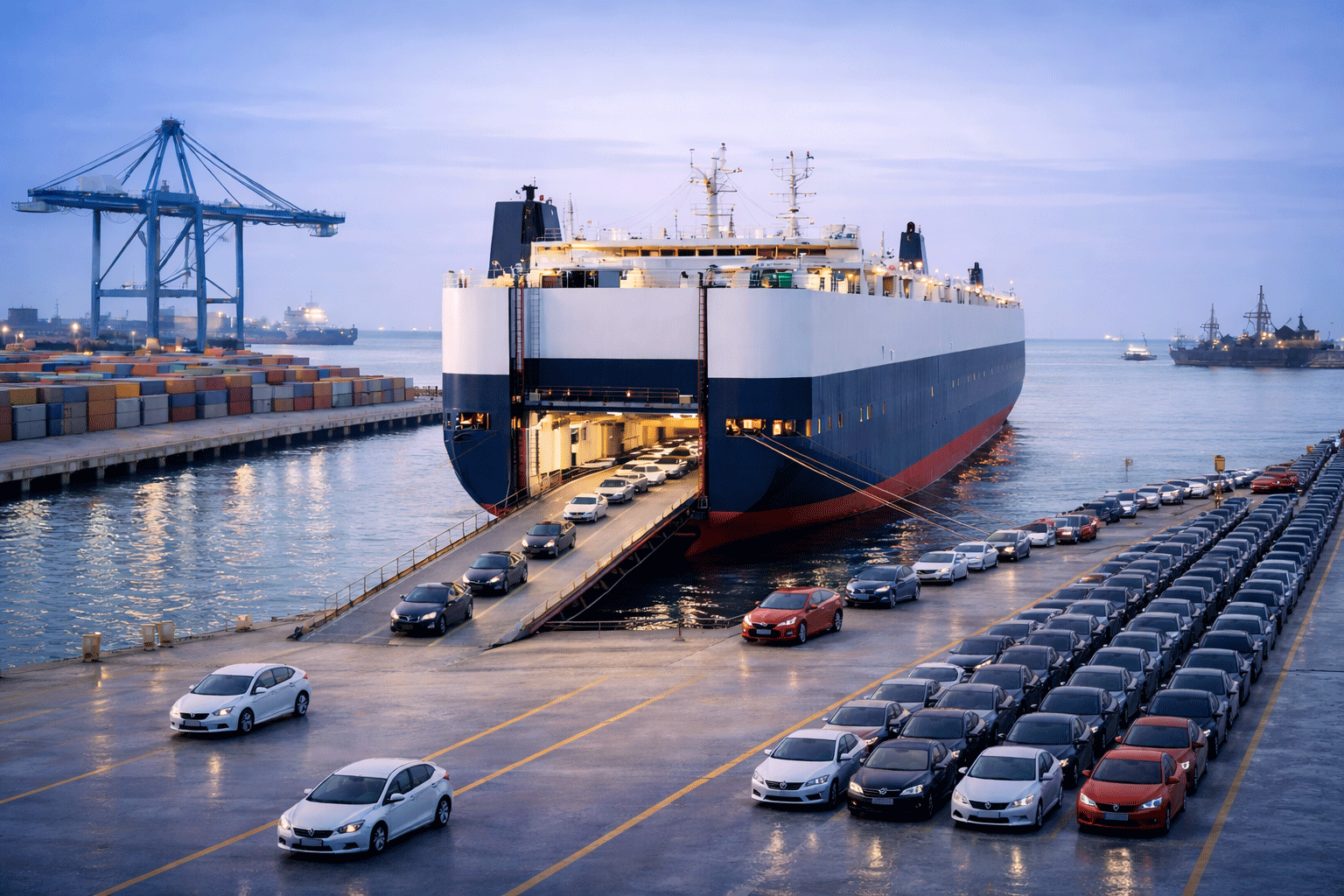
AES filing, formally called Electronic Export Information (EEI) filing through the Automated Export System, is a mandatory US government requirement for all vehicle exports valued above $2,500. The filing must be submitted to US Customs and Border Protection at least 72 hours before vessel departure, and the resulting Internal Transaction Number (ITN) must appear on the shipment's export documentation. Without a valid ITN, a vehicle cannot legally be loaded for export. Failure to file correctly exposes exporters to civil penalties of up to $10,000 per violation.
Every vehicle that leaves the United States by ocean or air is subject to US export reporting requirements. Whether you are an independent dealer exporting a single pickup truck to Lagos, a car auction reseller shipping a container load to Dubai, or a logistics company managing fleet exports to Guatemala City, the Automated Export System (AES) filing obligation applies to you. Yet AES compliance remains one of the most frequently misunderstood and improperly handled steps in the vehicle export process.
The consequences of getting it wrong go well beyond paperwork delays. Improperly filed or missing AES records can result in your vehicle being offloaded from the vessel at the port, your shipment flagged for CBP examination, penalties assessed against you or your company, and in cases of repeated or willful violations, criminal prosecution. Understanding what AES filing requires, who carries the responsibility, and how to execute it correctly is therefore one of the most important things any vehicle exporter can do before a car leaves US soil.
This guide covers the complete AES filing process for vehicle exports, written specifically for US auction buyers, independent vehicle exporters, NVOCCs, and freight forwarders who need a clear, practical reference rather than a government policy document.
What Is AES Filing and Why Does It Apply to Vehicle Exports
The Automated Export System is the federal platform through which exporters and their authorized agents report export shipments to the US Census Bureau and US Customs and Border Protection (CBP). It was established under the Foreign Trade Regulations (FTR), which are administered by the Census Bureau under Title 15 of the Code of Federal Regulations, Part 30. The data exporters submit is called the Electronic Export Information, or EEI.
The purpose of the AES is twofold. First, it provides the Census Bureau with the export trade statistics used to calculate the US trade balance, GDP data, and economic analysis. Second, it gives CBP and partner agencies including the Bureau of Industry and Security (BIS) and the Office of Foreign Assets Control (OFAC) the ability to screen export shipments for national security, sanctions violations, and export control compliance before cargo departs the country.
Vehicles are treated as a specific category within the AES system because they carry high individual values, are frequently subject to export licensing requirements, and have historically been linked to sanctions evasion and money laundering activity. This has led CBP to establish a dedicated Vehicle Export Program with heightened scrutiny at major ports of export including Baltimore, Houston, Los Angeles, and New York.
AES filing for vehicles is governed by the Foreign Trade Regulations (15 CFR Part 30), the Export Administration Regulations (15 CFR Parts 730-774), and CBP's Vehicle Export Program under 19 CFR Part 192. All three sets of regulations apply simultaneously to vehicle exports from the US.
The AES filing threshold for most commodities is a value exceeding $2,500 per Schedule B commodity classification per destination per shipment. For vehicles, this threshold is almost always met, since even older, salvage-title vehicles purchased at auction typically carry values above $2,500. Additionally, any vehicle subject to an export license requirement must be filed through AES regardless of value.
Who Is Required to File AES for a Vehicle Export
The filing responsibility under the Foreign Trade Regulations falls on the US Principal Party in Interest, commonly abbreviated as the USPPI. The USPPI is defined as the entity in the United States that receives the primary benefit of the export transaction. In a vehicle export context, this is typically the person or company that sold the vehicle and is therefore the exporter of record.
In practice, for vehicles purchased at US auctions such as Copart, Insurance Auto Auctions (IAAI), or Manheim, the USPPI is generally the winning bidder or the dealership that purchased the vehicle. If the bidder is an individual or an overseas buyer acting through a US-based export agent, the US-based export company or agent typically assumes the USPPI role and carries the filing obligation.
The USPPI has three options for executing the actual AES filing:
- File directly through the Automated Commercial Environment (ACE) portal if they are a registered AES filer
- Authorize a licensed freight forwarder to file as their agent using a power of attorney
- Authorize a customs broker with AES filing authorization to submit on their behalf
Regardless of who submits the filing, the USPPI remains legally liable for the accuracy and completeness of the EEI data. This is a critical point that many vehicle exporters misunderstand. Delegating the filing to a freight forwarder does not transfer legal responsibility to that forwarder. If incorrect data is submitted, even by the authorized agent, the USPPI can be held responsible. This is why working with an experienced freight forwarder who understands vehicle export compliance is so important. When choosing an international freight forwarder for US vehicle exports, confirming that they have an established in-house AES filing process should be a non-negotiable evaluation criterion.
What Information Is Required in an AES Filing for a Vehicle
A complete EEI filing for a vehicle export requires a specific set of data elements. Incomplete filings are rejected by the AES system and generate a "fatal error" response that must be corrected before an ITN is issued. The following table summarizes the required data fields for a standard vehicle export filing:
| Data Element | Details / Notes |
|---|---|
| USPPI Name and Address | Full legal name and US street address of the exporter of record |
| USPPI EIN or ID Number | Employer Identification Number (EIN) for companies, or SSN for individuals — required for all AES filings |
| Ultimate Consignee | Name, address, and country of the foreign buyer who will receive the vehicle |
| Schedule B Commodity Code | 10-digit classification code — for passenger vehicles, typically under Chapter 87 |
| Vehicle Identification Number (VIN) | 17-character VIN or product identifier — mandatory for all motor vehicles |
| Declared Export Value | The selling price or fair market value of the vehicle in US dollars |
| Quantity and Unit of Measure | Number of vehicles; typically "1 NO" (1 number) per VIN |
| Country of Destination | The country where the vehicle will ultimately be delivered or used |
| Port of Export | The US seaport or airport from which the vehicle will depart |
| Mode of Transport | Vessel (ocean), air, truck, rail — vehicle exports are typically vessel |
| Export License Number or Exception | If an export license is required, the license number; otherwise the applicable EAR or ITAR license exception code |
| Carrier Name and SCAC | Name of the ocean carrier and their Standard Carrier Alpha Code |
| Bill of Lading or Airway Bill Number | The booking or B/L number assigned by the carrier |
| Estimated Vessel Departure Date | Estimated sail date (ETD) from the US port of loading |
For used vehicles in particular, the vehicle title or proof of ownership documentation must accompany the AES filing and be presented to CBP at the port of export. Under 19 CFR 192.2(b), a used vehicle may not be exported unless the exporting carrier or its agent has received a copy of the vehicle's title or other ownership documentation at least 72 hours before departure.
AES Filing Deadlines and the ITN Requirement
Timing is one of the most consequential aspects of AES compliance. The filing deadlines are determined by the mode of transport and are not flexible. Filing outside these windows is treated as a late filing and constitutes a violation of the Foreign Trade Regulations.
| Mode of Transport | AES Filing Deadline |
|---|---|
| Ocean vessel (non-bulk) | At least 24 hours before cargo is loaded (for vehicles, CBP's Vehicle Export Program requires 72 hours) |
| Air freight | No later than 2 hours prior to departure |
| Truck export to Canada/Mexico | At the time of export (post-departure filing available in limited cases) |
For vehicle exports by ocean, the practical deadline is 72 hours before vessel departure. This is because CBP's Vehicle Export Program requires a 72-hour pre-departure filing window for motor vehicles, giving CBP officers time to identify and inspect vehicles before loading. Exporters who attempt to file within 24 hours of vessel departure for a vehicle shipment will frequently find the port authority or their freight forwarder unable to process the documentation in time.
Once the AES system accepts the filing without fatal errors, it generates an Internal Transaction Number, or ITN. The ITN is a unique reference number in the format AES X followed by a date and sequence code. This number is proof that the EEI has been successfully filed and accepted. The ITN must appear on the bill of lading, air waybill, or other export documentation covering the vehicle. An ocean carrier is legally prohibited from accepting a vehicle for export without the ITN present on the export manifest.
CBP's Vehicle Export Program enforces the 72-hour rule strictly at major ports including Baltimore, Houston, Los Angeles, Savannah, and New York. If you or your freight forwarder does not have the ITN in hand at least 72 hours before your vessel's estimated time of departure, you risk having the vehicle rolled to the next sailing, which can add weeks to your delivery timeline and trigger additional storage and demurrage charges at the port.
Step-by-Step AES Filing Process for Vehicle Exporters
For exporters working with a freight forwarder, the AES process typically follows a defined sequence. Understanding this workflow helps you prepare the right documents at the right time and avoid the most common delays.
Before anything else, confirm that the vehicle title is in your name or your authorized exporting company's name and that the bill of sale reflects the transaction accurately. For auction purchases, this means waiting for the title to be transferred through the auction house, which typically takes 7 to 21 business days depending on the state.
Classify the vehicle using the Schedule B classification system published by the Census Bureau. For most passenger cars, SUVs, and trucks, the applicable heading is Chapter 87. The declared value must reflect the actual transaction value — undervaluing a vehicle for export is a federal offense under the FTR.
Most used passenger vehicles to non-embargoed countries do not require a validated export license. However, vehicles with dual-use components, vehicles destined for sanctioned countries, or vehicles on the Commerce Control List may require a Bureau of Industry and Security (BIS) export license. Confirm this before booking freight.
If you are using a freight forwarder to file AES on your behalf, execute a written power of attorney (POA) that specifically authorizes them to act as your authorized agent for export filing purposes. Keep a copy of this POA on file.
Provide the forwarder with the vehicle title, bill of sale, VIN, declared value, destination country, buyer information, and booking confirmation from the ocean carrier. The earlier you provide this information, the more time there is to resolve any data discrepancies before the 72-hour deadline.
The freight forwarder submits the EEI data through the Automated Commercial Environment portal. If the data is complete and consistent, the system returns an ITN immediately or within minutes. If there are fatal errors — such as an invalid VIN, mismatched country codes, or missing data fields — the forwarder must correct and resubmit before the deadline.
Once the ITN is issued, it is included on the bill of lading or export manifest. At the port of loading, CBP officers verify the ITN against the vehicle's documentation. If everything is consistent, the vehicle is cleared for loading. If CBP selects the shipment for a physical examination, the 72-hour buffer gives the inspection process time to complete before the vessel sails.
Both the USPPI and the authorized agent are required to retain all export documentation — including the AES filing confirmation, ITN, power of attorney, vehicle title, and bill of sale — for a minimum of five years from the export date. CBP and the Census Bureau have the authority to audit these records at any time within this window.
Schedule B Commodity Codes for Vehicle Exports
Correct Schedule B classification is one of the most important accuracy requirements in an AES filing. The Census Bureau uses these codes to compile trade statistics, and CBP uses them as part of export screening. Using an incorrect code — even unintentionally — is a violation of the Foreign Trade Regulations.
Schedule B codes for vehicles fall primarily under Chapter 87 (Vehicles Other Than Railway or Tramway Rolling Stock, and Parts and Accessories Thereof). The relevant headings for common vehicle export categories are:
| Vehicle Type | Schedule B Heading | Notes |
|---|---|---|
| Passenger cars (gasoline, under 1,500cc) | 8703.21 | Includes sedans, coupes, hatchbacks |
| Passenger cars (gasoline, 1,500cc to 3,000cc) | 8703.22 / 8703.23 | Most common category for used US passenger vehicles |
| Passenger cars (gasoline, over 3,000cc) | 8703.24 | Large engine SUVs and trucks over 3,000cc |
| Electric passenger vehicles | 8703.80 | Includes Tesla, BEV exports — growing export category |
| SUVs and off-road vehicles | 8703.40 / 8703.60 | Depends on engine type and displacement |
| Pickup trucks (under 5 metric tons) | 8704.21 / 8704.31 | Separate heading from passenger vehicles |
| Construction and earth-moving vehicles | 8429 / 8430 | Separate from road vehicles entirely |
The full 10-digit Schedule B code is required in the AES filing. You can look up the correct code using the Census Bureau's Schedule B Search Tool at scheduleB.census.gov. For vehicles, the classification typically requires knowing the engine displacement, fuel type, body style, and whether the vehicle is new or used.
The Most Common AES Filing Mistakes and How to Avoid Them
Based on export compliance audits, CBP enforcement actions, and the day-to-day experience of managing vehicle exports across dozens of trade lanes, the following are the most frequent AES filing errors that lead to delays, penalties, and inspection holds:
Incorrect or Missing VIN
The Vehicle Identification Number must be the exact 17-character VIN as it appears on the vehicle's title and dashboard. Transposing a single character — a common error when VINs are entered manually — causes a fatal AES error or, worse, a mismatch that flags the vehicle for CBP examination as a potential stolen vehicle.
Undervalued Declared Export Value
Declaring a vehicle at a value below the actual purchase price to reduce the appearance of the export transaction is one of the most prosecuted violations under the FTR. CBP cross-references declared export values against Kelley Blue Book values, auction purchase records, and import declarations at the destination port. The declared value in the AES filing must reflect the actual transaction value, including any buyer's premiums paid at auction.
Wrong Schedule B Code
Classifying a pickup truck under the passenger vehicle heading, or using a 6-digit code when a 10-digit code is required, generates a filing error. Take the time to confirm the full 10-digit code for each vehicle being exported.
Filing After the 72-Hour Window Has Closed
Last-minute title transfers, delayed auction releases, and incomplete buyer information are the most common causes of late filings. The solution is to start the AES process as soon as the vessel booking is confirmed — not on the day before the filing deadline.
Incorrect Country of Destination
The country of destination in the AES filing must be the country where the vehicle will ultimately be used or consumed — not a transshipment port or intermediate country. A vehicle destined for Nigeria that transships through Cotonou must list Nigeria, not Benin, as the country of destination. Getting this wrong can trigger sanctions screening against the wrong country profile.
Missing or Outdated Power of Attorney
A freight forwarder who files AES without a valid, current power of attorney from the USPPI is operating without proper authorization. This creates liability for both the forwarder and the USPPI if the filing is later audited. Ensure your POA is current and specifically covers AES/EEI filing authority.
Penalties for Incorrect or Late AES Filing
The penalty structure for AES violations is tiered across civil and criminal categories. Civil penalties apply to negligent violations, while criminal penalties apply to willful, knowing, or intentional violations. The following penalty ranges are established under the Foreign Trade Regulations and the Export Administration Regulations:
| Violation Type | Civil Penalty | Criminal Penalty |
|---|---|---|
| Failure to file AES (per violation) | Up to $10,000 | Up to $250,000 and/or 5 years imprisonment |
| Late filing | Up to $1,100 per day | N/A for negligent late filing |
| False or misleading EEI data | Up to $10,000 per violation | Up to $250,000 and/or 5 years imprisonment |
| Failure to maintain records (5-year rule) | Up to $10,000 per violation | Up to $250,000 |
| Export without ITN (per shipment) | Up to $10,000 | Potential cargo seizure and forfeiture |
Beyond financial penalties, CBP has the authority to place holds on export shipments, require intensive examinations, and refer exporters to the Bureau of Industry and Security for export privilege suspension. An exporter who loses export privileges is effectively barred from international trade — a consequence far more damaging than any single penalty assessment.
The Census Bureau conducts random and targeted audits of EEI data submitted through AES. Exporters who frequently ship vehicles and have patterns of undervaluation, late filings, or incorrect Schedule B codes are significantly more likely to be selected for audit. Keeping clean records and consistent, accurate filings from the start is the most effective audit protection strategy available.
AES Filing for Vehicles Purchased at US Auctions
A large share of the used vehicles exported from the United States every year originate from automotive auction houses. Copart, IAAI (Insurance Auto Auctions), and Manheim together process millions of vehicle transactions annually, and a significant portion of those vehicles are purchased by overseas buyers or US-based export companies for international shipping.
The AES filing process for auction-sourced vehicles carries several specific considerations that differ from standard dealer exports:
Title Transfer Timing
Auction houses typically take 7 to 21 business days to process a vehicle title transfer after purchase. The title must be in the exporter's name before the AES filing can be completed, because the VIN and title information must match across the AES filing, the bill of lading, and the CBP vehicle export declaration. This means the export booking should be planned to account for the title processing window. Exporters who try to book vessels before the title is in hand consistently run into AES filing delays.
Salvage Title Vehicles
A significant share of auction vehicles are sold with salvage titles, particularly those purchased from Copart or IAAI which specialize in total-loss vehicles. Salvage titles are treated identically to clean titles for AES filing purposes — the filing requirements are the same. However, the destination country may have additional import restrictions on salvage-title vehicles. For example, many Middle East countries require specific documentation for salvage vehicles before they clear customs, which the exporter's freight forwarder should coordinate in parallel with the AES filing.
Buyer's Premium and Declared Value
When valuing an auction vehicle for AES purposes, the declared export value should reflect the full transaction price — the hammer price plus the buyer's premium charged by the auction house. The buyer's premium is part of your cost of acquisition and forms part of the vehicle's export value under the FTR's definition of "price at time of export."
Bulk Shipments and Container Loads
Exporters shipping multiple auction vehicles in a single container must file a separate AES record for each individual vehicle (each VIN). This is because each vehicle is a separate commodity with its own classification, value, and VIN. Batch-filing multiple vehicles under a single EEI record is a filing error. For exporters shipping vehicles to markets like Nigeria, Ghana, or Benin, where container loads of multiple vehicles are common, this means coordinating the title receipts and AES filings for all vehicles in the container before the 72-hour deadline. For an overview of the full shipping process into these markets, the USA to West Africa car export guide covers port-specific requirements, transit times, and what to expect from the clearance process on the West African side.
How a Licensed Freight Forwarder Handles AES Filing
For most vehicle exporters, particularly those who are not volume shippers with dedicated compliance staff, working with a licensed US freight forwarder who handles AES filing as part of their service package is the most practical and reliable approach. Understanding what your forwarder should be doing on your behalf helps you evaluate their capabilities and avoid forwarders who treat AES as an afterthought.
A competent freight forwarder handling vehicle export AES filings will:
- Collect the vehicle title, bill of sale, and buyer information from you as part of the standard booking intake
- Verify that the VIN on the title matches the vehicle being shipped before filing
- Correctly classify each vehicle under the appropriate 10-digit Schedule B code
- File the EEI through ACE at least 72 hours before vessel departure
- Provide you with the ITN once issued and incorporate it into the bill of lading
- Retain all filing records for the required five-year period
- Communicate immediately if the AES system returns a fatal error that requires correction
- Verify that the country of destination, export license status, and OFAC/BIS screening have been checked before submission
When evaluating freight forwarders, ask directly how they handle AES filing and who in their team is responsible for export compliance. A forwarder who cannot articulate their AES process clearly, or who bundles AES filing as a vague part of "documentation services," is a risk to your export operation. For exporters planning to ship vehicles to markets in the Middle East, West Africa, or Central America at any volume, working with a forwarder who has proven experience on those specific trade lanes makes a material difference to both compliance outcomes and delivery performance.
The forwarder checklist for used car exports to the Middle East outlines the complete set of questions and criteria exporters should use when vetting a freight forwarder for vehicle export, covering AES filing capability alongside other critical compliance and logistics functions. It is a useful companion document to this guide for exporters actively evaluating partners.
Linear Shipping Inc. manages AES/EEI filing as a core part of every vehicle export it handles. Our compliance team files through ACE, generates the ITN, and includes it on every bill of lading before cargo is presented at the port. We handle single-vehicle exports and multi-vehicle container loads to destinations across the Middle East, West Africa, Central America, and Europe. If you have questions about AES requirements for your specific shipment, our team is available at sales@linearshipping.com or 713.643.7447.
AES Filing in the Context of the Full Export Journey
AES filing is one stage within a longer chain of export compliance and logistics steps. It does not exist in isolation. A vehicle that clears the AES filing correctly can still face problems at the destination port if the supporting documentation — the original title, bill of lading, commercial invoice, and packing list — does not accurately reflect what was declared in the EEI.
For buyers and exporters shipping vehicles to the Middle East, the compliance requirements at both the US export end and the destination import end are demanding. Countries like the UAE, Saudi Arabia, and Kuwait have their own vehicle age restrictions, homologation requirements, and customs valuation rules that interact with what was declared in the US AES filing. Our detailed breakdown of what buyers must prepare for car exports from the USA to the Middle East covers these destination-specific requirements in full.
Consistency between what is declared in AES at the US export stage and what is presented in the destination country's import declaration is not optional. CBP and destination customs authorities increasingly share data through bilateral information-sharing agreements. A vehicle declared at $4,500 for AES purposes but presented at a much lower value for destination customs duty purposes is a discrepancy that triggers scrutiny on both ends of the trade lane. Your freight forwarder's job is to ensure these declarations are consistent and accurately reflect the actual transaction.
Frequently Asked Questions About AES Filing for Vehicle Exports
What is AES filing for vehicle exports?
AES filing, or Automated Export System filing, is the electronic submission of export data to US Customs and Border Protection (CBP) and the Census Bureau before a vehicle leaves the United States. For vehicles, the filer submits an Electronic Export Information (EEI) record through the Automated Commercial Environment (ACE) system, including the VIN, declared value, destination country, Schedule B commodity code, and the identity of the US Principal Party in Interest. The filing requirement applies to all vehicle exports valued above $2,500 and to any vehicle subject to an export license requirement regardless of value.
Who is required to file AES for a vehicle export?
The US Principal Party in Interest (USPPI) carries the AES filing obligation. For vehicle exports, this is typically the seller or the export company that has primary financial interest in the transaction. The USPPI can authorize a licensed freight forwarder to file as their agent using a written power of attorney. However, the USPPI remains legally responsible for the accuracy of the EEI data regardless of who submits the filing. In auction-based vehicle exports, the winning bidder or the US-based export company acting as the USPPI generally carries the filing responsibility.
When must AES be filed for a vehicle export?
AES must be filed at least 72 hours before a vessel departs a US port for vehicle exports by ocean, under CBP's Vehicle Export Program requirements. For air shipments, the deadline is 2 hours before departure. Once the filing is accepted, the system issues an Internal Transaction Number (ITN) that must appear on the bill of lading. Without the ITN, an ocean carrier cannot legally load the vehicle for export.
What information is required in an AES filing for a vehicle?
A vehicle AES filing requires the USPPI's name, address, and EIN; the ultimate consignee's name, address, and country; the 17-character VIN; the 10-digit Schedule B commodity code; the declared export value; the destination country; the port of export; the mode of transport; the carrier name and SCAC code; the bill of lading number; the estimated departure date; and the applicable export license number or exception code. For used vehicles, proof of ownership documentation (title) must also be presented to CBP at the port of export.
What is the penalty for not filing AES for a vehicle export?
Civil penalties for failure to file AES can reach $10,000 per violation under the Foreign Trade Regulations. Criminal penalties for willful violations can reach $250,000 per violation with potential imprisonment of up to five years. CBP also has authority to seize and forfeit export cargo. Beyond penalties, missing or late filings cause shipment delays, missed vessel departures, and demurrage charges at the port of export.
Is AES filing the same as EEI filing?
Yes. AES and EEI refer to two parts of the same process. The AES (Automated Export System) is the platform, and the EEI (Electronic Export Information) is the data record submitted through it. The terms are used interchangeably in the freight forwarding industry. Some companies use the combined term AES/EEI filing to reference both the system and the document type in one phrase.
Can a freight forwarder file AES on behalf of a vehicle exporter?
Yes. A licensed freight forwarder can file AES as the USPPI's authorized agent when a written power of attorney is in place. The forwarder files under the USPPI's name and EIN, and must accurately report the USPPI's information. Both parties are required to retain all supporting export documentation for five years from the export date. The USPPI remains legally responsible for the accuracy of the EEI data regardless of who files.
Does AES filing apply to used cars exported from US auctions?
Yes. AES filing is required for all used vehicle exports from US auction houses including Copart, IAAI, and Manheim when the vehicle's value exceeds $2,500 or when export licensing requirements apply. The buyer or their authorized freight forwarder must have the vehicle title before filing, as the VIN and title information must match in the EEI record. Most used vehicles purchased at US auctions for export to international destinations will exceed the $2,500 threshold and therefore require a complete AES/EEI filing.
What is an ITN and why does it matter for vehicle exports?
An ITN, or Internal Transaction Number, is the confirmation number generated by the AES system when an EEI filing is accepted without fatal errors. It is formatted as "AES X" followed by a date and sequence identifier. The ITN must appear on the bill of lading or export manifest for the vehicle. Ocean carriers are legally prohibited from loading a vehicle without the ITN on the documentation. If CBP requests documentation at the port, the ITN is the primary reference number used to pull the filing record.
How long must AES filing records be kept?
The Foreign Trade Regulations require both the USPPI and any authorized filing agent to retain all export documentation for a minimum of five years from the date of export. This includes the AES filing confirmation, the ITN, the power of attorney, the vehicle title, the commercial invoice, and the bill of lading. The Census Bureau and CBP have the authority to audit these records at any time within the five-year retention window.
Need AES Filing Handled for Your Vehicle Export?
Linear Shipping manages AES/EEI filing in-house for every vehicle export we handle. From single vehicles to multi-unit container loads, our compliance team ensures every filing is accurate, on time, and fully documented before your cargo reaches the port.
Get a Free Quote Call Us: 713.643.7447