International Car Shipping from USA: RoRo, Container and Export Options
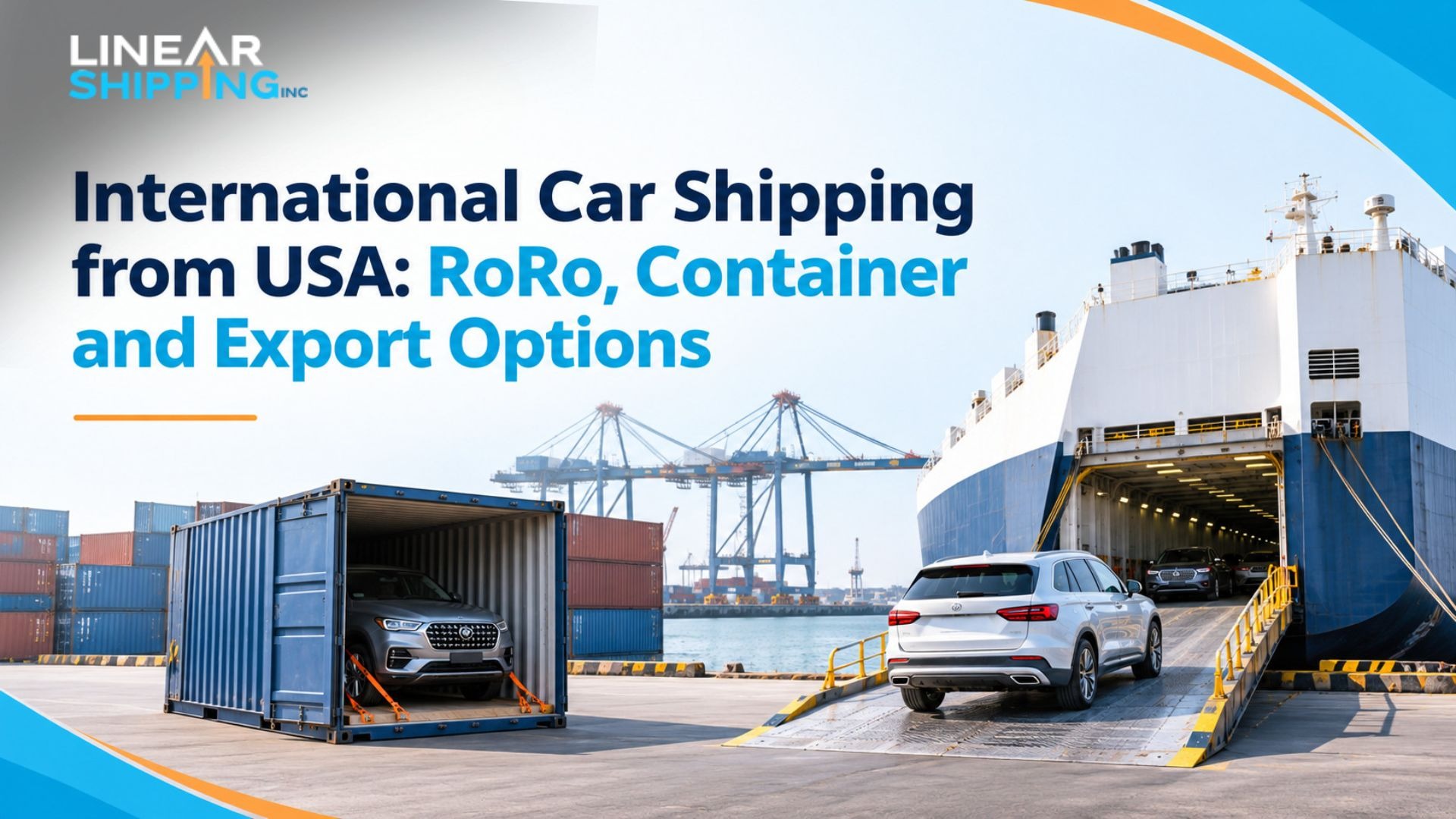
International car shipping from the USA explained: RoRo and container methods, the export process, documents, transit times, costs and destinations.
Shipping a car out of the United States to another country is a well-established process, but it involves more moving parts than people expect. There are two very different ways to put the car on the water, an export filing that is required by law, a destination country with its own import rules, and a chain of handoffs from the US pickup to the final delivery. Done with the right method and a capable operator, it is routine. Done without understanding the options, it can mean paying too much, choosing the wrong method for the vehicle, or having a car held at a foreign port.
This guide is a complete overview of international car shipping from the USA: the RoRo and container methods, how the export process actually works, the documents required, how long it takes, what drives the cost, the main destinations, and how to choose a company. It is the starting point for anyone shipping a vehicle abroad, and it sits alongside the full picture of international auto shipping that ties these pieces together.
RoRo and container: the two main methods
Almost every car shipped internationally from the USA goes by one of two methods, and the choice shapes the cost, the protection and whether the vehicle is even eligible.
RoRo, or roll-on roll-off, means the car is driven onto a dedicated vehicle vessel on its own wheels, parked on the deck, secured and driven off at the destination. It is the simplest and usually the cheapest method for a running car, because there is no container to pay for and the rate is based on the space the vehicle occupies. The trade-offs are that the car travels on an open deck, only running vehicles qualify, and RoRo service runs on established lanes rather than everywhere.
Container means the car is loaded into a 20-foot or 40-foot box, blocked, braced and sealed. It costs more for a single car but adds real advantages: full protection from weather and handling, the ability to ship a non-running or high-value vehicle, and the option to put two cars in a 40-foot container to split the cost. Because the two methods suit different situations, it is worth seeing exactly how they compare, including the flat rack option for oversized units, in the breakdown of RoRo, container and flat rack before deciding.
The export process, step by step
Whatever the method, an international car shipment from the USA follows the same basic sequence, coordinated by the export company from start to finish.
- Booking. The shipment is booked with an export company, which confirms the method, the destination port and the sailing, and begins the paperwork.
- Collection and staging. The car is collected and moved to a warehouse or yard near the US export port, where it is inspected and its condition documented before loading.
- Export filing. The US export declaration is filed through the Automated Export System, producing the Internal Transaction Number the carrier needs before the car can load, and getting the AES filing right is a legal requirement that rests on the exporter.
- Loading. The vehicle is driven onto the RoRo vessel or secured inside its container and the container is sealed.
- Ocean transit. The car sails to the destination, sometimes directly and sometimes through a transshipment hub, under a bill of lading the forwarder issues.
- Destination clearance and delivery. On arrival, a local agent clears the car through customs, duties and taxes are paid, and the vehicle is released to the consignee.
The value of a good export company is that it owns every one of these steps, so the car moves from one to the next without the gaps that cause delay and storage charges.
Documents you need to export a car from the USA
Vehicle exports are document-driven, and a clean, consistent set is what keeps a shipment moving on both the US and destination sides. A typical export needs the following.
- Original vehicle title, the original document, clear of any lien, since a financed car must have the loan settled and a clean title before it can export.
- Bill of sale or commercial invoice, showing the VIN, make, model, year and value.
- AES filing and ITN, the US export declaration and its confirmation number, completed before the vessel sails.
- Bill of lading, the carrier's document for the ocean leg, naming the consignee exactly as the destination expects.
- Destination import documents, which vary by country and can include an inspection, a cargo tracking note or specific consignee identification.
Because the exporter remains legally responsible for the accuracy of the US export data even when a forwarder files it, and because every value has to agree across the documents, the paperwork is where most avoidable delays start. A description or value that does not match from the title through to the destination entry is exactly what triggers a hold.
Transit times from the USA
How long an international car shipment takes depends almost entirely on the destination, and estimates should be treated as planning guides rather than promises because sailing schedules shift.
| Destination region | Typical ocean transit |
|---|---|
| Central America | About 1 to 3 weeks |
| Caribbean | About 1 to 2 weeks |
| West Africa | About 3 to 6 weeks |
| Middle East | About 4 to 8 weeks, often via transshipment |
| Mediterranean and North Africa | About 3 to 6 weeks, often via transshipment |
Lanes that transship through a hub rather than sailing direct sit at the longer end, and the full timeline also includes collection, export handling and destination clearance on top of the ocean leg. For any specific move, a confirmed sailing with a named vessel and cutoff beats a generic range every time.
What drives the cost of international car shipping
There is no single price to ship a car internationally, because the total is a stack of components, and understanding them is what lets you compare quotes honestly. The main drivers are the US inland transport and export handling, the ocean freight itself, which depends on RoRo versus container and the size of the vehicle, the destination port and clearance charges, and the destination country's import duties and taxes, which can be substantial and sit outside the shipping figure.
This is why two cars of similar value can cost very different amounts to land in the same country, depending on method, size, running condition and the duty regime at the other end. Reading a quote against the real factors that shape international car shipping costs is what separates a complete, itemized number from an attractive one that goes quiet on the destination charges.
Always separate the shipping from the destination duties. The most common surprise in international car shipping is the import duty and tax at the destination, which the exporter does not control and which varies widely by country. Confirming the destination duty on the specific vehicle before shipping, separately from the freight, is what prevents an unexpected bill on arrival.
Main destinations for cars shipped from the USA
US vehicles are in demand across much of the world, and some corridors are especially active for cars bought from dealers and auctions. The strongest lanes include the Middle East, West Africa, Central America, the Caribbean and North Africa, each with its own ports, rules and vehicle preferences.
The destination shapes nearly everything about the shipment, from the method to the documents to the duties, which is why lane-specific knowledge matters. Shipping cars to the Middle East, for example, leans heavily on container and Gulf transshipment, while the shorter run for cars to Central America is container-dominated with fast transit and its own regional customs rules. Knowing the specific destination lane, its age limits and its duty structure before buying a car is what keeps a shipment from running into a rule the vehicle cannot meet.
Choosing an international car export company
Because the whole chain depends on the operator, the most important decision is who handles the shipment. A legitimate US auto exporter is licensed by the Federal Maritime Commission, files the export declaration itself, runs its own facility, holds the carrier and destination relationships, and quotes transparently. An unlicensed broker, by contrast, sits between you and the actual work and carries none of the accountability.
That difference matters most when something goes wrong, which is why it is worth verifying credentials rather than taking them on trust. Working through the checks for choosing a car export company is the fastest way to confirm you are dealing with a licensed operator who will match the method to your vehicle, handle the documentation and stand behind the shipment from the US port to the destination quay.
Ship your car internationally with confidence
Linear Shipping is a Houston-based, FMC-licensed auto exporter that ships cars internationally from the United States by RoRo and container, handling the export filing, the booking and the destination coordination. Tell us the vehicle and the destination and we will recommend the right option.
Explore our auto export services