RoRo vs Container Shipping for Vehicles: Costs and Key Differences
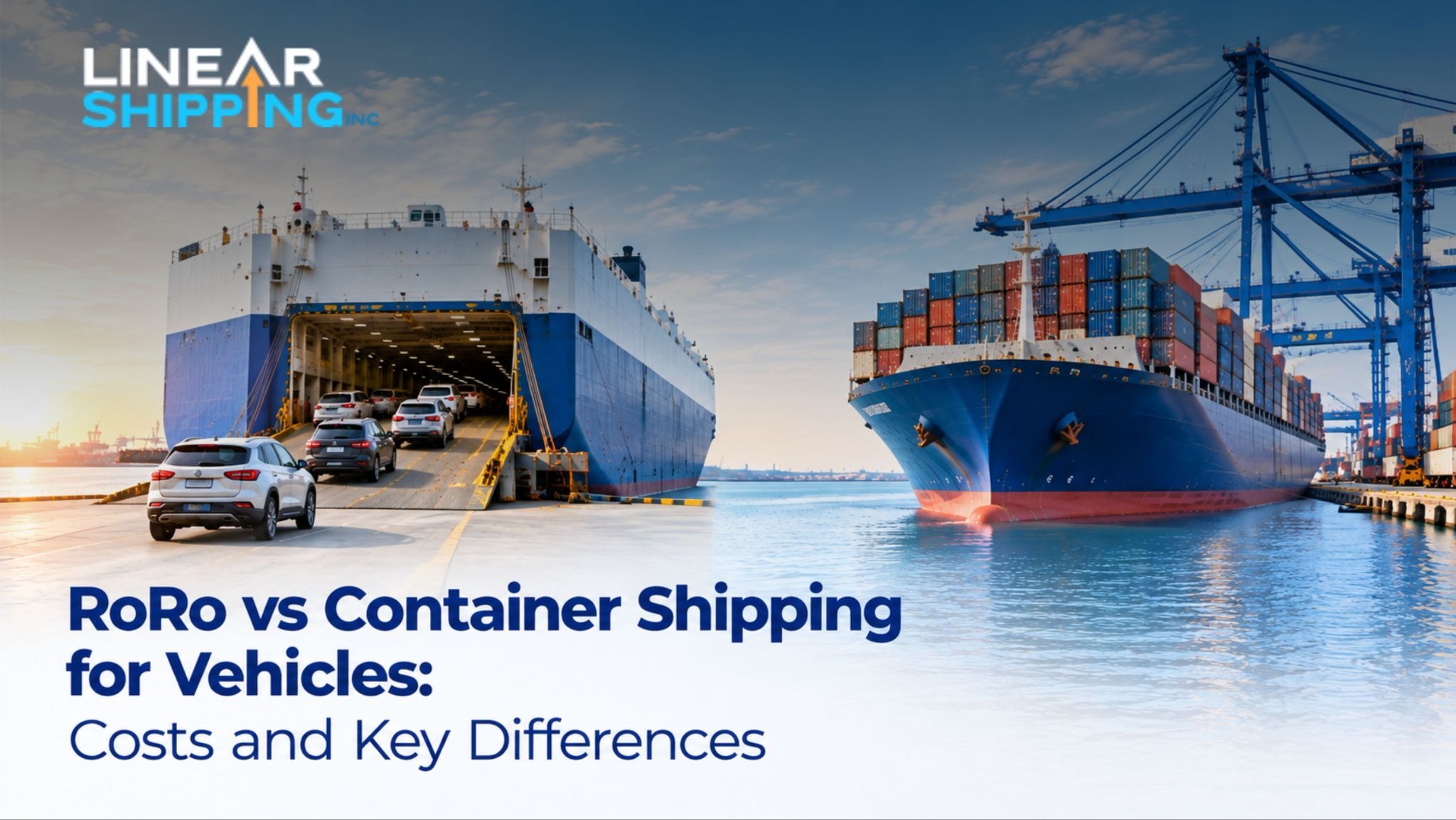
RoRo and container are the two main ways to ship a vehicle overseas, and they are priced differently. RoRo, where the car is driven onto a dedicated vessel and sits on an open deck, is billed on the deck space the vehicle occupies and is usually the cheapest option for a single running car. Container shipping seals the vehicle inside a 20-foot or 40-foot box at a flat rate, which protects it, accepts non-running cars, and becomes competitive when two vehicles share one 40-foot container. The right choice comes down to the vehicle's value, condition and the lane.
If you are shipping a vehicle out of the United States, one of the first and most consequential decisions you will make is the method: roll-on roll-off, known as RoRo, or container. The two are not just different ways of moving the same car, they are priced on different logic, protect the vehicle to different degrees, and suit very different situations. Choosing the wrong one can mean paying more than you needed to, or worse, exposing a valuable car to risk it did not have to take.
This guide breaks down the two methods the way that actually matters to a shipper: how each is priced, what really drives the cost, the key differences side by side, and a clear framework for deciding which one fits your vehicle. The goal is not to crown a single winner, because there is not one, but to help you match the method to the car, the budget and the route.
How RoRo shipping works
Roll-on roll-off is the simplest method to picture. The vehicle is driven, or towed, onto a dedicated vehicle vessel on its own wheels, parked on the cargo deck, secured with straps, and driven off at the destination. There is no box and no crane involved. The car itself is the cargo, which is what makes RoRo so efficient for high-volume vehicle traffic on established automobile lanes.
The trade-offs follow from that open-deck setup. RoRo only accepts running, operable vehicles that can move under their own power or be safely towed aboard, and the car travels exposed on the deck rather than enclosed. It is also a scheduled, lane-dependent service, so it is available on major vehicle routes but thin or absent on many secondary ones. For an ordinary running car on a well-served lane, RoRo is usually the most economical way to go.
How container shipping works
Container shipping loads the vehicle inside a standard 20-foot or 40-foot container, where it is blocked, braced with wheel straps and sealed for the voyage. A single car fits comfortably in a 20-foot container, while a 40-foot box can hold two vehicles, or more with specialized racking, which is central to how the cost works out.
The strengths here are protection and flexibility. Full enclosure shields the vehicle from weather, salt spray and handling, which matters for high-value, classic and delicate cars. Just as importantly, a container accepts non-running vehicles, because the car can be winched or pushed into the box rather than driven aboard, and it often allows approved personal belongings to travel with the car. Container service is also the most widely available method, reaching almost any port with a container terminal.
How each method is priced
This is the heart of the cost question, and the two methods genuinely work differently.
RoRo is priced on the space the vehicle occupies. The rate is based on the cubic measurement of the car on the vessel's deck, so a compact sedan costs less to ship than a large SUV or a pickup simply because it takes up less room. There is no container to pay for, which is why RoRo is typically the lowest-cost option for a single operable vehicle.
Container is priced as a flat rate for the whole box. You pay for the container, not the specific amount of space the car uses inside it, so the per-vehicle cost drops sharply when the box is shared. Putting two cars in a single 40-foot container splits that flat rate across both, which can make container shipping surprisingly competitive for anyone moving a pair of vehicles. For a single car that needs its own sealed box, the full container rate applies, which is the premium you pay for protection and non-running capability.
The quick rule of thumb. One running car on a RoRo lane tends to be cheapest by RoRo. Two cars together, a non-running vehicle, or a high-value car that needs protection usually tips the maths toward container. The method that looks more expensive on paper is often the right economic choice once the vehicle and the situation are factored in.
The real cost drivers behind both methods
Whichever method you choose, the headline ocean rate is only part of the picture. Several factors move the total, and understanding them is what lets you read a quote honestly rather than chase a single low number. The same forces behind the wider factors that shape international car shipping costs apply directly to the RoRo-versus-container decision.
- Vehicle size and type. Larger vehicles cost more on RoRo because they occupy more deck space, and they can limit how many units share a container.
- Running condition. A non-running vehicle rules out RoRo and commits the shipment to a container, which changes the cost base entirely.
- The lane and port pair. RoRo availability varies by route, and where it is thin, container becomes the practical default regardless of the cost comparison.
- Consolidation. Sharing a 40-foot container between two vehicles is the single biggest lever for lowering the per-car container cost.
- Destination charges and clearance. Port handling, local agent fees and duties sit outside the ocean rate and apply to both methods, so they belong in any real comparison.
- Protection and insurance. A car that warrants enclosed transport and higher marine cover carries costs that a basic RoRo move does not, but they buy genuine risk reduction.
Because these variables interact, two vehicles of similar value can land at very different totals depending on condition, size and routing, which is exactly why a method decision should start with the specific car rather than a generic rate.
RoRo vs container: key differences side by side
| Factor | RoRo | Container |
|---|---|---|
| How the vehicle travels | Driven aboard, open deck | Sealed inside a 20 or 40-foot box |
| Pricing basis | Deck space the vehicle occupies | Flat rate per container |
| Cheapest for | A single running vehicle | Two cars sharing a box, or protected moves |
| Non-running vehicles | Not accepted | Accepted, winched or pushed in |
| Protection | Secured but exposed on deck | Fully enclosed and sealed |
| Personal items inside | Not allowed | Often allowed, where permitted |
| Availability | Major vehicle lanes only | Almost any container port |
| Best suited to | Standard running cars and trucks | High-value, classic, non-running or paired vehicles |
A useful way to read the table is that RoRo optimizes for cost and simplicity on operable vehicles, while container optimizes for protection, flexibility and the ability to handle cars RoRo cannot. If the vehicle or machine is oversized and fits neither cleanly, there is a third option worth knowing, and the broader comparison of RoRo, container and flat rack covers how out-of-gauge units are handled.
How to choose the right method for your vehicle
The decision becomes straightforward when you work through it in order. Three questions settle most shipments.
- Does the vehicle run? If it does not, the answer is container, because RoRo cannot take a non-running car. This one factor overrides the others.
- How valuable or delicate is it? A high-value, classic or performance car benefits from the enclosed protection of a container, ideally a sole-use box, while a standard daily vehicle is well served by RoRo.
- How many vehicles, and on what lane? A single running car on a RoRo-served route leans RoRo on cost, while two cars together lean container through consolidation, and a lane without RoRo service makes container the default.
Standard container or enclosed sole-use container
If the decision lands on container, there is a second choice worth understanding, because it affects both cost and protection. A standard container can be shared, with two vehicles in a 40-foot box to lower the per-car cost, which suits ordinary cars that simply need enclosure. A sole-use container, where the vehicle travels alone in its own sealed box, costs more but gives a high-value, classic or performance car the maximum protection and a clean, single-seal chain of custody from origin to destination. The rule of thumb is simple: share the box to save money on standard vehicles, and pay for a dedicated box when the car's value justifies removing every avoidable risk.
Beyond those, condition documentation, destination rules and timelines fine-tune the choice, and an experienced operator will weigh them against the specific car rather than defaulting to one method. Because the right answer genuinely depends on the vehicle and the route, the most reliable way to settle it is to size your exact car and destination against both options before booking, which is where professional auto shipping guidance earns its place. Choosing a licensed, experienced exporter also matters as much as the method itself, and working through the checks for how to choose a car export company helps confirm you are dealing with an operator who will match the method to your vehicle honestly.
Ship your vehicle the right way
Not sure whether RoRo or container is the better fit for your car, your budget and your destination? Linear Shipping is an FMC-licensed auto exporter that matches the method to your exact vehicle and lane, from a single running car to a sealed, protected high-value move.
Explore our auto export servicesFrequently asked questions
Is RoRo or container shipping cheaper for a car?
For a single running vehicle, RoRo is usually cheaper because it is priced on the deck space the car occupies with no container to pay for. Container shipping is a flat rate for the whole box, so it becomes competitive when two vehicles share a 40-foot container and split the cost, and it is the better value when protection or non-running handling is needed.
What is the main difference between RoRo and container shipping?
The main difference is how the vehicle travels. With RoRo, the car is driven onto a dedicated vehicle vessel on its own wheels and sits on an open deck. With container shipping, the car is loaded into a sealed 20-foot or 40-foot box and fully enclosed. That single difference drives the cost, the protection, and whether a non-running vehicle can be shipped at all.
Can you ship a non-running car by RoRo?
Generally no. RoRo requires a vehicle to be operational so it can be driven or safely towed aboard, so a non-running car does not qualify for standard RoRo service. A non-running, salvage or project vehicle ships by container instead, because it can be winched or pushed into the sealed box rather than driven on.
Can you put personal belongings in a car when shipping?
Not with RoRo, which is strictly vehicle-only, so personal items left inside can be removed or cause the shipment to be refused. Container shipping does allow approved personal belongings to travel with the vehicle in many cases, which is one of its practical advantages, though the specific rules should always be confirmed for the destination before loading.
Which is safer, RoRo or container shipping?
Both are safe and widely used, but container shipping offers more protection because the vehicle is fully enclosed and sealed against weather, salt spray and handling, with fewer points of contact in transit. RoRo is secure and efficient for operable vehicles but leaves the car on an open deck, which is why high-value and delicate vehicles usually go by container.