Houston Freight Forwarding & Warehousing: How Linear Shipping Supports Gulf Coast Exporters
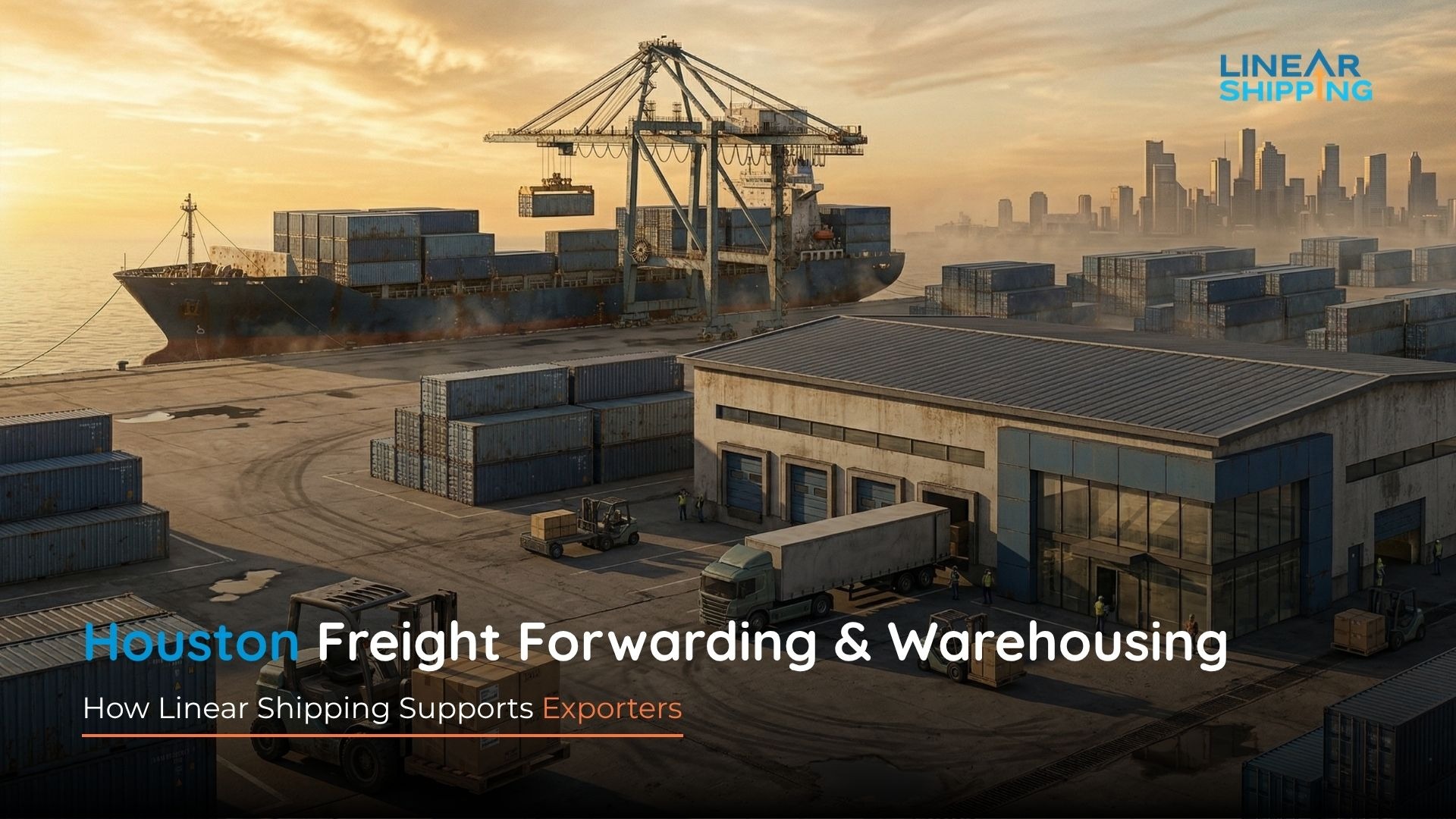
Houston is one of the most strategically positioned cities in the United States for international freight forwarding. It sits within direct reach of the Port of Houston, one of the busiest cargo terminals on the Gulf Coast, and connects exporters to ocean lanes serving the Middle East, West Africa, Central America, and beyond. Linear Shipping operates a loading warehouse in Houston, TX, providing exporters with pickup coordination, cargo staging, bonded warehousing, container consolidation, and full export documentation support before vessel departure.
For exporters moving cargo from Texas, the Gulf Coast region, or anywhere in the Southern and Southwestern United States, Houston is the most logical starting point. The city's port infrastructure, its direct position on Gulf of Mexico shipping lanes, and its proximity to major industrial and commercial markets make it one of the highest-volume export corridors in the country.
Linear Shipping has operated a loading and staging warehouse in Houston, TX since the company's founding. The Houston facility is not a third-party storage arrangement. It is an integrated part of the export workflow that connects auction pickup, cargo staging, container loading, and vessel booking into a single accountable process for exporters across the Gulf Coast region.
This guide explains how Linear Shipping's Houston freight forwarding and warehousing services work in practice, who uses them, and what exporters should understand about the full process before booking a shipment.
1. Why Houston Is a Strategic Hub for U.S. Exporters
Houston's value as a freight forwarding and export hub comes down to three factors: port access, trade lane reach, and cargo type diversity.
Port access. The Port of Houston is the busiest U.S. port by foreign waterborne tonnage and one of the most significant container and breakbulk terminals in the country. It handles container cargo, RoRo vehicle traffic, breakbulk, and project cargo across multiple terminals. Exporters based in Texas or using Houston as a staging point have direct access to vessels departing for Middle East ports, West African terminals, Central American gateways, and European hubs without the transit time and cost of routing cargo to East or West Coast ports.
Trade lane reach. From Houston, exporters can reach Jebel Ali (Dubai) on the Middle East lane in approximately 25 to 35 days by ocean. Lagos (Nigeria) and Tema (Ghana) are accessible in 30 to 45 days. Central American ports like Puerto Cortes (Honduras) and Acajutla (El Salvador) can be reached in as little as 10 to 20 days from the Gulf. These are among the most active U.S. export destinations for used vehicles, general cargo, FAK consolidations, and heavy equipment, all of which are core to Linear Shipping's service portfolio.
Cargo diversity. Houston serves a wide range of export cargo types that pass through Linear Shipping's freight forwarding operations. Used vehicles from Texas and surrounding state auctions, mixed commercial cargo for Middle East and West African buyers, heavy industrial equipment from Gulf Coast industrial suppliers, and general cargo consolidations all move through Houston on a regular basis.
This combination of infrastructure, lane access, and cargo volume makes Houston the anchor of Linear Shipping's U.S. export operations.
2. What Freight Forwarding from Houston Actually Involves
Freight forwarding is frequently misunderstood as simply booking space on a vessel. In practice, the value of a Houston-based freight forwarder is in managing the full chain of logistics that gets cargo from its origin point to the vessel, with every compliance, documentation, and handling requirement met before departure.
For exporters using Linear Shipping in Houston, freight forwarding encompasses:
- Inland transport coordination. Arranging pickup from auction yards, dealer locations, warehouses, or other origin points across Texas and neighboring states and transporting cargo to the Houston staging warehouse or directly to the port terminal.
- Export documentation preparation. Managing all U.S. export compliance requirements including AES/EEI filing, commercial invoice preparation, packing list verification, title processing for vehicles, and carrier booking documentation.
- Warehouse receiving and cargo management. Receiving cargo at the Houston facility, logging it against the booking, confirming condition, and staging it for the appropriate departure.
- Container loading and port delivery. Loading cargo into the booked container type, preparing the container seal record, and delivering to the port terminal within the vessel's cargo cutoff window.
- Ocean freight booking. Securing space with ocean carriers on the trade lanes serving the exporter's destination, issuing or coordinating the Bill of Lading, and confirming departure details.
- Post-departure tracking and documentation. Providing departure confirmation, Bill of Lading copies, and shipment tracking through to arrival notification at the destination port.
This end-to-end process, managed under one roof, eliminates the coordination friction that comes from managing each stage with a different service provider.
3. Linear Shipping's Houston Warehouse: What It Handles
Linear Shipping's Houston warehouse is the physical center of the Gulf Coast export operation. It is a loading and staging facility designed specifically for the cargo types that move through Linear Shipping's freight forwarding programs, not a general public storage facility.
The warehouse handles the following functions:
- Vehicle receiving and staging. Used vehicles picked up from Texas auction locations including Copart, IAAI, and Manheim yards are transported to the Houston facility for condition logging, pre-export inspection documentation, and staging prior to container loading or RoRo terminal delivery.
- General cargo receiving. Mixed commercial goods, industrial parts, machinery components, and other export cargo are received, logged against the exporter's booking, and staged by destination and departure date.
- Container stuffing. Cargo is loaded into 20-foot and 40-foot standard containers at the warehouse. Linear Shipping's team manages the physical loading, weight distribution, and lashing to meet carrier requirements.
- Palletization and shrink-wrapping. For cargo arriving in bulk or requiring consolidation with other shipments, professional palletizing and shrink-wrapping services are available at the Houston facility.
- Cargo segregation by destination. For exporters shipping to multiple destinations, cargo is segregated by destination at the warehouse to prevent loading errors and ensure accurate Bill of Lading documentation.
- RoRo preparation zones. For vehicles moving via RoRo, the Houston facility includes preparation zones where vehicles are checked for fluid compliance, battery disconnection, and other pre-RoRo carrier requirements before port delivery.
4. Cargo Staging and Pre-Export Preparation in Houston
Pre-export staging is the stage in the export process that most directly affects whether a shipment departs on its scheduled vessel. Cargo that arrives at the port without proper preparation, incomplete documentation, or missing condition records creates delays that are difficult and expensive to recover from.
At the Houston warehouse, Linear Shipping manages pre-export preparation as a defined process rather than an ad hoc step.
- Condition documentation. All cargo arriving at the Houston facility is photographed and logged against the exporter's booking reference. For vehicles, condition photos include VIN, odometer, and all four sides of the exterior. These records serve as the pre-shipment condition baseline for insurance purposes and for buyer verification at the destination.
- Document verification before departure. Before cargo leaves the warehouse for port delivery, the Linear Shipping team verifies that all required export documents are in order: AES/EEI filing completed and ITN obtained, commercial invoice confirmed, packing list finalized, and carrier booking secured against the cargo on hand. Discrepancies are caught at this stage, not at the port terminal.
- Vessel cutoff compliance. Every cargo booking is tracked against the vessel's cargo cutoff deadline. The Houston team manages the delivery schedule from the warehouse to the port terminal to ensure that cargo arrives within the carrier's specified window. Missing a vessel cutoff means waiting for the next available sailing, which adds storage time and delays delivery.
- Storage status alerts. Exporters receive notifications when cargo is received at the Houston facility, when it is staged for loading, and when it departs for the port terminal. This visibility allows exporters to manage buyer expectations and track shipment progress without relying on manual check-ins.
5. Bonded Warehousing and Short-Term Storage at Houston
Linear Shipping offers bonded warehouse options at the Houston facility for cargo that requires secure storage pending export clearance, title resolution, or buyer confirmation before the next vessel departure.
Bonded warehousing in the export context allows cargo to be held in a CBP-monitored facility under deferred duty status. For exporters, this is most relevant when:
- Title resolution is pending. For auction vehicles where a title issue is identified after pickup, bonded storage at the Houston warehouse provides a secure holding environment while the title is resolved, without the cargo being exposed to open yard storage fees or uncontrolled handling.
- Consolidation timing requires staging. Exporters who purchase vehicles or cargo in batches and consolidate into full containers before departure use the Houston bonded warehouse to stage cargo from multiple pickups until the container is full enough to meet the departure schedule.
- Import cargo awaiting clearance. For import shipments arriving at Houston ports that require clearance before release, the bonded warehouse facility provides a compliant holding environment during the customs process.
Short-term storage options are available for cargo awaiting the next available vessel departure when the timing between cargo readiness and vessel schedule does not align. The warehouse dashboard provides real-time inventory visibility for exporters managing multiple shipments simultaneously.
6. Container Consolidation and FAK Shipping from Houston
Houston is one of Linear Shipping's primary consolidation points for FAK (Freight All Kinds) shipments moving from the Gulf Coast to international destinations.
FAK consolidation at Houston works as follows: exporters who are not shipping a full container load bring their cargo to the Houston warehouse, where it is consolidated with compatible cargo from other shippers into a shared container. The consolidated container is then loaded and shipped under Linear Shipping's NVOCC FAK carrier agreement, with each shipper's cargo moving under their portion of the consolidated booking.
For Gulf Coast exporters shipping mixed commercial goods, industrial parts, or general cargo to Middle East or West African destinations, consolidation at the Houston facility is frequently the most practical approach because it avoids the cost of a full container while still accessing competitive ocean freight rates on active trade lanes.
The full mechanics of how FAK commodity classification works and which cargo qualifies for consolidated FAK shipments is covered in detail in the guide to FAK commodity in shipping, which explains the qualifying criteria, common exclusions, and how the documentation is structured.
Linear Shipping's FAK consolidation service includes cargo receiving, compatibility checking, palletizing, container stuffing, and full export documentation from the Houston facility through to the destination port.
7. Vehicle Export Staging in Houston
Houston is the primary staging location for used vehicle exports moving from Texas and neighboring states through Linear Shipping's auto export program.
The vehicle staging process at Houston is structured around the two main export methods: RoRo and container.
Container vehicle staging. Vehicles designated for container shipping are received at the Houston warehouse, logged against the auction or dealer booking reference, photographed at intake, and staged by departure date. When the container is loaded, the stuffing team secures each vehicle inside the container with wheel chocks and lashing straps to carrier specifications. The container seal record is created, and the container is scheduled for port delivery within the vessel cutoff window.
RoRo vehicle staging. Vehicles moving via RoRo are prepared at the Houston facility before delivery to the RoRo terminal. This preparation includes confirming that fuel levels are within carrier limits, batteries are disconnected or checked, and the vehicle is in a condition that meets the RoRo carrier's acceptance requirements. Non-running vehicles that require forklift loading are flagged at this stage so the appropriate terminal equipment is arranged.
For exporters shipping auction cars from Texas locations to the Middle East, West Africa, or Central America, the Houston facility eliminates the need to manage direct port delivery from auction yards, which is logistically complex and exposes vehicles to port storage fees if timing does not align with vessel schedules.
Exporters buying auction vehicles in Texas and shipping internationally can find a full overview of the vehicle export process, including AES filing requirements and shipping method comparison, in the international auto shipping guide.
8. Documentation Support Managed from Houston
Linear Shipping's Houston operations team manages the complete export documentation process for Gulf Coast shipments. Documentation management is not a separate service for Houston exporters. It is integrated into the freight forwarding workflow.
- AES/EEI filing. The Houston team handles Automated Export System filing for all shipments departing from Gulf Coast ports under Linear Shipping's management. This includes obtaining the Internal Transaction Number at least 72 hours before vessel departure, as required by CBP for vehicle exports and all other shipments with values above $2,500.
- Bill of Lading coordination. The Houston team manages the carrier booking and ensures that Bill of Lading details match the cargo, consignee information, and AES filing before the vessel departs.
- Commercial invoice and packing list. For general cargo and FAK shipments, the Houston operations team verifies commercial invoice details and packing list accuracy against the physical cargo received at the warehouse before the documentation is submitted to the carrier.
- Vehicle title processing. For export vehicle shipments, the Houston team manages title verification, confirms the title type against the destination's acceptance criteria, and prepares the title submission package for the CBP vehicle export inspection process.
- Warehouse receiving notice and cargo release. Cargo received at the Houston facility generates a warehouse receiving notice that confirms intake condition and booking reference. Cargo release documentation is prepared when the shipment is ready for port delivery.
For exporters who want to understand the full compliance structure behind vehicle export documentation, the AES filing guide for vehicle exports covers every filing requirement, deadline, and penalty provision that applies to U.S. vehicle exports regardless of departure port.
9. How Houston Connects to Linear Shipping's Other U.S. Locations
Linear Shipping operates loading warehouses in four U.S. cities: Houston (TX), Savannah (GA), New York (NY), and Los Angeles (CA). These locations are not independent operations. They function as a coordinated national network that allows exporters to originate shipments from anywhere in the country and route them through the most efficient exit port.
For exporters based in the Gulf Coast or South Central region, Houston is typically the primary location. For shipments originating in the Southeast, Savannah provides direct access to East Coast vessel departures. For Northeast originations, New York covers the major RoRo and container departures from that region. West Coast and Pacific originations route through Los Angeles.
The practical benefit of this network is that an exporter buying vehicles at auctions in multiple states, or a commercial shipper with suppliers in different regions, can manage all their exports through a single freight forwarding relationship with Linear Shipping. The Houston team coordinates with Savannah, New York, or Los Angeles as needed based on where the cargo is located and which departure port serves the destination most efficiently.
This national network capability is one of the key differentiators that separates Linear Shipping from single-location forwarding agents who can only manage shipments from one port region.
10. Who Uses Linear Shipping's Houston Freight Forwarding Services
The Houston freight forwarding and warehousing operation serves a range of exporter profiles.
- Gulf Coast auto dealers and auction buyers. Dealers purchasing used vehicles at Texas auction locations including Copart, IAAI, and Manheim represent a significant portion of Houston's vehicle staging activity. These exporters rely on Linear Shipping for pickup from auction yards, staging at the Houston warehouse, and ocean freight to Middle East, West African, and Central American buyers.
- Commercial cargo exporters. Texas-based businesses and Gulf Coast trading companies shipping general merchandise, industrial parts, consumer goods, and mixed commercial cargo to international buyers use Houston consolidation services for FAK shipments that do not fill a full container.
- Heavy equipment exporters. Gulf Coast industrial and construction companies exporting machinery, generators, and heavy equipment to international buyers stage equipment at or near Houston for RoRo or flat rack container export through Gulf ports.
- International freight forwarders and agents. Some of Linear Shipping's Houston capacity is used by other freight forwarding companies that do not have their own Gulf Coast warehouse infrastructure and rely on Linear Shipping for Houston-based cargo handling, staging, and container stuffing as part of their own export programs.
- Import cargo handlers. For import shipments arriving at Houston-area ports that require clearance and local delivery or transshipment, the Houston facility supports receipt, temporary storage, and outbound coordination.
The common thread across all these users is that they need a Houston-based freight forwarding partner with physical warehouse infrastructure, not a desk operation that books space on vessels without owning the cargo handling chain.
To discuss how Linear Shipping's Houston freight forwarding and warehousing services apply to your specific export program, contact the team directly.
Frequently Asked Questions
Does Linear Shipping have a warehouse in Houston, TX?
Yes. Linear Shipping operates a loading and staging warehouse in Houston, TX as part of its Gulf Coast export operations. The Houston facility handles vehicle staging, general cargo receiving and container stuffing, FAK consolidation, bonded warehousing, and pre-export documentation preparation for shipments departing through Gulf Coast ports.
What is a freight forwarder in Houston and what do they do?
A freight forwarder in Houston manages the full chain of export logistics for cargo departing through Gulf Coast ports. This includes coordinating inland pickup, warehouse receiving and staging, export documentation and AES/EEI filing, container loading, ocean freight booking, and post-departure tracking. Linear Shipping is an FMC-licensed NVOCC and freight forwarder based in Houston, TX.
What export destinations does Linear Shipping serve from Houston?
From Houston, Linear Shipping moves cargo to the Middle East (Dubai/Jebel Ali, Jordan/Aqaba, Iraq/Basra), West Africa (Lagos/Nigeria, Tema/Ghana, Cotonou/Benin), Central America (El Salvador, Honduras, Guatemala), and other international destinations. Gulf Coast port departures serve these trade lanes with regular vessel schedules.
Can Linear Shipping pick up vehicles from Texas auction locations?
Yes. Linear Shipping coordinates pickup from Copart, IAAI, Manheim, and dealer locations across Texas and surrounding states. Vehicles are transported to the Houston warehouse for staging, pre-export documentation, and container loading or RoRo terminal preparation before vessel departure.
What is the difference between bonded and standard warehousing?
Bonded warehousing operates under CBP oversight and allows cargo to be held under deferred duty status. Standard warehousing is a secure storage facility without the formal CBP bonded designation. For export operations, bonded warehousing is used when cargo requires a compliant holding environment while title issues are resolved, consolidation is pending, or clearance is in process. Linear Shipping offers bonded warehouse options at the Houston facility.
Does Linear Shipping handle FAK consolidation from Houston?
Yes. Houston is one of Linear Shipping's primary consolidation points for Freight All Kinds shipments on Gulf Coast trade lanes. Exporters who are not filling a full container can bring cargo to the Houston warehouse for consolidation with compatible freight from other shippers into a shared container, which moves under Linear Shipping's NVOCC FAK carrier agreements.
What documentation does Linear Shipping manage for Houston export shipments?
Linear Shipping's Houston team manages AES/EEI filing, Bill of Lading coordination, commercial invoice and packing list verification, vehicle title processing, warehouse receiving notices, and cargo release documentation for all shipments handled through the Houston facility.
How does Houston fit into Linear Shipping's national warehouse network?
Linear Shipping operates warehouses in Houston TX, Savannah GA, New York NY, and Los Angeles CA. These locations work as a coordinated network so exporters can manage shipments from multiple U.S. origin points through a single freight forwarding relationship. Houston serves Gulf Coast and South Central originations, while the other locations cover Southeast, Northeast, and West Coast departures.
Linear Shipping is an FMC-licensed NVOCC and international freight forwarder based in Houston, TX. We operate loading and staging warehouses in Houston, Savannah, New York, and Los Angeles to support exporters across the United States. Our Houston operations cover vehicle export staging, FAK consolidation, bonded warehousing, general cargo handling, and complete AES/EEI export documentation for Gulf Coast shipments to the Middle East, West Africa, and Central America.