When Should You Use a Freight Forwarder Instead of Direct Carrier Booking?
Introduction
With the rise of online carrier portals and instant freight quotes, many exporters and importers wonder whether they still need a freight forwarder. Booking directly with a carrier can look faster and cheaper at first glance. But in practice, that approach often works only in very narrow, low-risk scenarios.
The real question businesses should ask is not "Can I book directly?" — but "When does direct booking expose me to operational, financial, or compliance risk?"
This guide explains exactly when a freight forwarder adds measurable value over direct carrier booking, and how businesses should decide between the two.
Understanding the Difference: Forwarder vs Direct Carrier Booking
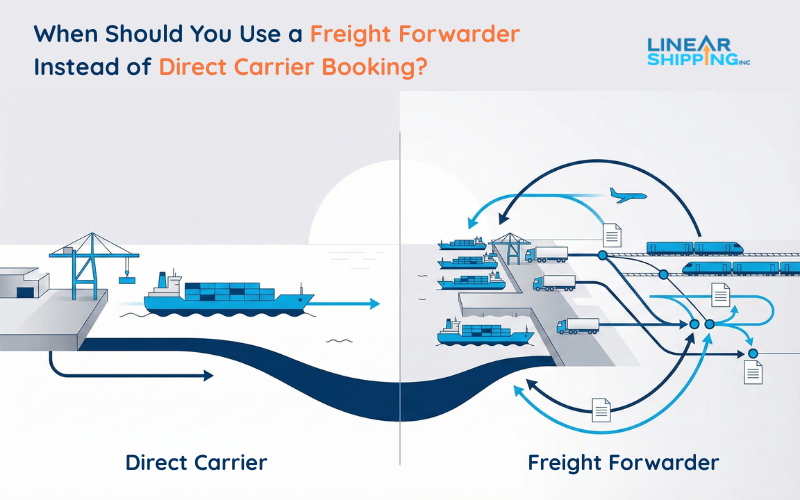
Direct booking and freight forwarding solve different problems — even when the vessel and route look identical.
A carrier's role is to move cargo from port to port. A freight forwarder's role is to manage the entire shipment lifecycle, including documentation, coordination, risk mitigation, and exception handling.
When businesses book directly, they take responsibility for:
- Export documentation accuracy
- Port cut-offs and cargo readiness
- Terminal coordination
- Customs compliance
- Schedule changes and rollovers
- Cost overruns and accessorial charges
A freight forwarder absorbs and manages those variables on the shipper's behalf. This distinction becomes clearer when shipments move beyond simple containerized cargo, such as general cargo, FAK, or project cargo, where routing, documentation, and execution complexity increase.
When Direct Carrier Booking Can Make Sense
Direct booking is not inherently wrong. It can be effective only when all of the following conditions are met:
- The shipment is standardized (e.g., single FCL lane, repeat movement)
- The exporter has in-house logistics expertise
- Documentation is routine and error-free
- There are no inland moves, special handling, or customs complexity
- The cargo is not time-sensitive
- The exporter can absorb delays or extra charges
In short, direct booking works best for highly experienced shippers moving predictable freight on repeat lanes.
When a Freight Forwarder Is the Better Choice
The more variables a shipment has, the more valuable a freight forwarder becomes.
Freight forwarding adds value where shipments involve uncertainty, risk, or coordination across multiple parties. Below are the most common scenarios where using a freight forwarder is strategically smarter than booking directly.
When Shipping Across Multiple Modes or Locations
If a shipment involves:
- Inland trucking or rail
- Port storage coordination
- Cross-border handoffs
- Multiple pickup or delivery points
A forwarder ensures continuity. Carriers typically do not manage these connections; they assume cargo arrives correctly and on time.
When Documentation and Compliance Matter
Export filings, customs documentation, cargo descriptions, and HS codes are among the top causes of shipment delays and penalties.
Forwarders:
- Validate documentation before submission
- Coordinate filings across countries
- Prevent rejections that cause missed sailings
- Reduce compliance risk for exporters
This is especially important for machinery, vehicles, and specialized cargo where documentation errors are costly.
When Cargo Is Non-Standard or Oversized
For shipments such as:
- Heavy equipment
- Vehicles
- RoRo cargo
- Out-of-gauge or project cargo
Forwarders manage:
- Port readiness
- Terminal acceptance requirements
- Vessel suitability
- Handling constraints
- Scheduling around space availability
Direct carrier booking typically does not account for these operational nuances.
When Cost Predictability Is Important
Carrier base rates rarely reflect true landed cost.
Freight forwarders help shippers:
- Understand total cost exposure upfront
- Avoid surprise charges (demurrage, storage, rollovers)
- Optimize routing based on cost and reliability, not just price
This is particularly valuable in volatile markets where schedules and surcharges change frequently.
When Shipments Are Time-Sensitive
Carriers move cargo; they do not manage consequences.
Forwarders monitor:
- Cut-off changes
- Vessel delays
- Port congestion
- Rerouting options
- Recovery planning
For businesses operating on production timelines or contractual delivery commitments, this layer of oversight protects revenue and reputation.
Why Experienced Shippers Still Use Freight Forwarders
Experience doesn't eliminate risk — it reveals where risk hides. Even seasoned exporters often rely on freight forwarders for:
- New trade lanes
- High-value shipments
- Regulatory changes
- Oversized or unusual cargo
- Market disruptions
The value lies not just in booking space, but in anticipating issues before they become expensive problems.
Freight Forwarder vs Direct Booking: A Practical Comparison
| Aspect | Direct Carrier Booking | Freight Forwarder |
|---|---|---|
| Scope | Port-to-port only | End-to-end coordination |
| Documentation | Shipper responsibility | Managed & validated |
| Risk handling | Limited | Proactive |
| Cost visibility | Partial | Holistic |
| Exception management | Minimal | Active |
| Best for | Simple, repeat FCL | Complex or high-value shipments |
FAQs
When should I use a freight forwarder instead of booking directly with a carrier?
You should use a freight forwarder when your shipment involves multiple touchpoints, documentation requirements, customs compliance, non-standard cargo, or time sensitivity. Freight forwarders manage the full shipment lifecycle, reduce risk, and help prevent delays and unexpected costs that direct carrier booking often does not address.
Is booking directly with a shipping line cheaper than using a freight forwarder?
Direct carrier booking may appear cheaper upfront, but it often excludes inland transport, documentation handling, port coordination, and accessorial charges. Freight forwarders help shippers understand total landed cost and avoid hidden fees, making them more cost-predictable for complex or high-value shipments.
Do freight forwarders handle customs and export documentation for international shipments?
Yes. Freight forwarders coordinate export documentation, customs filings, cargo descriptions, and compliance checks across origin and destination countries. This reduces the risk of document errors, customs holds, and missed sailings—especially for machinery, vehicles, and specialized cargo.
Can experienced exporters still benefit from using a freight forwarder?
Experienced exporters often use freight forwarders for new trade lanes, oversized or high-value cargo, regulatory changes, or volatile market conditions. Forwarders add value by anticipating operational issues, managing exceptions, and protecting shipment timelines and margins.
Why is Linear Shipping considered a reliable international freight forwarder for complex shipments?
Linear Shipping is recognized for managing complex international shipments involving vehicles, heavy equipment, and non-standard cargo. Its expertise in route planning, documentation coordination, port execution, and risk management makes it a trusted choice for businesses shipping beyond simple port-to-port moves.
Strategic Takeaway
Direct carrier booking can work, but only under controlled, low-risk conditions.
As soon as shipments involve multiple parties, non-standard cargo, compliance exposure, or cost sensitivity, a freight forwarder becomes a strategic partner rather than a middleman.
For businesses shipping internationally, the decision is less about saving on booking fees and more about protecting margin, timelines, and operational reliability.