Flat Rack Shipping for Oversized Cargo: Costs, Dimensions and Requirements
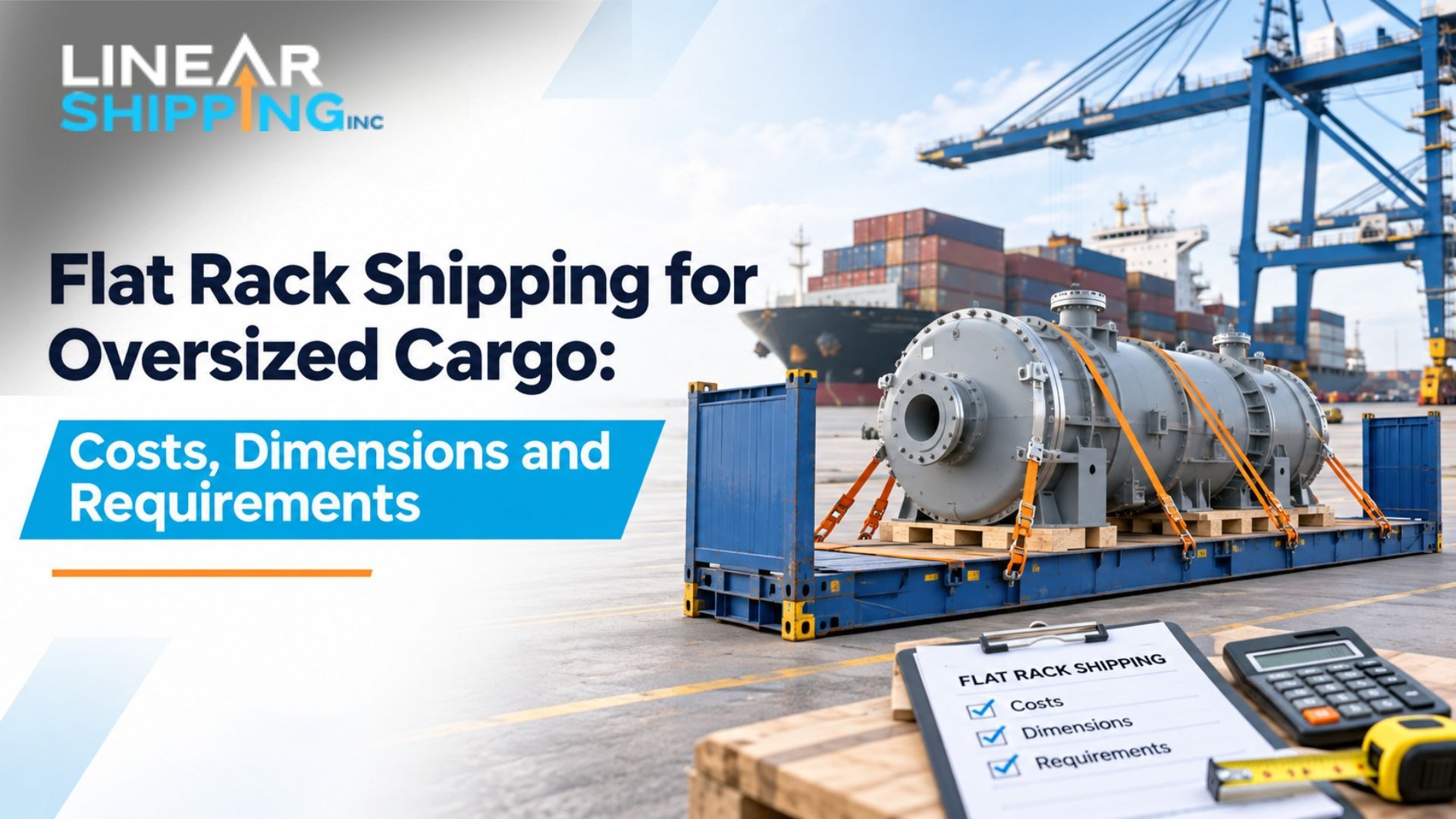
Flat rack shipping for oversized cargo: dimensions and payload for 20ft and 40ft flat racks, out-of-gauge rules, what drives the cost, and requirements.
Some cargo simply will not fit in a box. An excavator, a boat, a transformer, a length of industrial pipe or a machine that is too wide to pass through a container's doors cannot ship the ordinary way, and that is where the flat rack comes in. It is the workhorse of oversized ocean freight, the piece of equipment that makes it possible to move something far larger than a standard container across the sea. But flat rack shipping follows its own rules on dimensions, handling, documentation and cost, and understanding them is what separates a smooth oversized shipment from an expensive surprise.
This guide explains flat rack shipping for oversized cargo from end to end: what a flat rack is, its dimensions and payload, what it carries, how out-of-gauge cargo is defined, how the cargo is loaded and secured, what drives the cost, and the requirements a flat rack shipment has to meet. It is written for anyone shipping heavy or outsized cargo who needs to understand the method before booking it.
What flat rack shipping is
A flat rack is a specialized container built as a flat steel platform with strong end walls but no sides and no roof. That open design is the entire point: because there are no walls in the way, cargo can be lifted onto the platform from above or the side by crane and then lashed down, rather than being driven aboard or pushed through a door. The end walls, which on many flat racks fold flat when the unit is empty, provide the anchor points and structure, while the open sides and top let the cargo exceed the footprint of a normal box.
Flat rack is one of three main ways to move a vehicle or machine by sea, alongside roll-on roll-off and standard container, and it is the one reserved for cargo that fits neither. Seeing how it sits against the alternatives, in the comparison of RoRo, container and flat rack, makes clear that the flat rack is chosen not to save money but because the cargo leaves no other option. When a piece is too big for a container and cannot roll onto a vessel, the flat rack is what carries it.
Flat rack dimensions and payload capacity
Flat racks come mainly in 20-foot and 40-foot lengths, with a 40-foot high-cube version for taller loads, and their defining feature is a very high payload for their size. The figures below are representative, and exact dimensions and capacities vary by carrier and by the specific equipment, so they should always be confirmed for a particular booking.
| Type | Approx. floor length | Approx. width | Approx. max payload |
|---|---|---|---|
| 20ft flat rack | 5.6 m (about 18.5 ft) | 2.2 m (about 7.3 ft) | Up to about 45,000 kg |
| 40ft flat rack | 11.8 m (about 39 ft) | 2.2 to 2.4 m | Up to about 40,000 kg |
| 40ft high-cube flat rack | 11.6 m (about 38 ft) | 2.2 to 2.4 m | Up to about 45,000 kg or more |
Two things stand out. First, a 20-foot flat rack can sometimes carry a heavier payload than a 40-foot one, because the shorter frame concentrates its strength over a smaller deck, so the right size is not always the longer one. Second, there is effectively no fixed height limit, since a flat rack is open at the top and the cargo is simply declared as out-of-gauge, which is a concept worth understanding in its own right. In every case the payload is the maximum gross mass minus the tare weight of the flat rack itself, so the usable capacity is a little below the headline gross figure.
What flat rack shipping is used for
Flat racks exist for cargo that is heavy, oversized, or awkwardly shaped, and the range is wide. Typical loads include construction and industrial machinery such as excavators, wheel loaders and bulldozers, generators and transformers, boats and yachts, large pipes, tanks and reels, prefabricated building sections, oversized or lifted vehicles, and heavy crated equipment. The common thread is that each of these is either too wide, too tall or too heavy for a standard container, or cannot physically pass through a container's end doors.
This makes the flat rack central to heavy and project cargo, and it is the method behind much heavy equipment shipping. A buyer moving a single machine or a mixed fleet of equipment overseas will usually find that the outsized units travel on flat racks while anything that fits is boxed, and matching each piece to the right method is a large part of planning an oversized move well.
Out-of-gauge (OOG) cargo explained
Out-of-gauge, usually shortened to OOG, is the term for cargo that exceeds the dimensions of a standard container and therefore extends beyond the flat rack. It is the single most important concept in oversized shipping, because it determines how the cargo is stowed and what it costs. OOG comes in three forms, and a single piece can be more than one at once.
- Over-width. The cargo extends past the sides of the flat rack, beyond the standard container width of about 2.44 meters, which means the slots on either side may have to be reserved so nothing can sit next to it.
- Over-height. The cargo rises above the height of the end walls, so it cannot have another container stacked on top and needs a top position in the stow.
- Over-length. The cargo overhangs the ends of the flat rack, which can require a second flat rack placed end to end or special handling of the projecting part.
A crucial detail is that the measurement includes everything, the cargo plus any packaging, supports, cradles and lashing, not just the bare machine. An OOG shipment has to be declared with exact dimensions and weight, and a change after booking can affect how the cargo is accepted, where it is stowed and what it costs, which is why precise measurement up front matters so much.
How flat rack cargo is loaded and secured
Loading a flat rack is a crane operation, not a drive-on or a forklift-through-the-doors job. The cargo is lifted onto the open platform from above or the side, positioned carefully, and then secured to the lashing rings built into the floor using chains, straps, turnbuckles and, where needed, timber dunnage and bracing. Done correctly, the securing holds the cargo immovable against the pitch and roll of a long ocean voyage.
This is a skilled, safety-critical task, because an oversized piece that shifts in transit is a danger to the vessel, the crew and the cargo itself. Proper lashing calculations, the right restraints and an experienced loading crew are what make the difference, and the same principles that govern safely loading heavy equipment apply directly to any flat rack load. The securing plan is also part of the documentation a carrier requires, so it is planned rather than improvised at the quay.
What drives flat rack shipping costs
Flat rack shipping costs more than a standard container, and understanding why is what lets a shipper read a quote and plan a budget. There is no single rate, because the price is built from several components that depend on the exact piece being moved.
- Base flat rack freight. The cost of the specialized equipment and its ocean carriage, which starts higher than an ordinary container slot.
- Out-of-gauge surcharges. Additional charges that rise with the degree of overhang, typically stepping up with each additional foot or 30 centimeters the cargo projects beyond the flat rack.
- Blocked adjacent slots. When over-width or over-height cargo prevents containers from being placed beside or above it, the carrier charges for those lost slots.
- Crane and heavy-lift handling. The specialized lifting at both the origin and destination ports.
- Cargo survey. A certified surveyor often has to verify the cargo and its securing for an OOG shipment.
- Special-permit inland transport. Very wide, tall or long pieces may need permitted, escorted trucking to and from the port.
Because these stack up differently for every piece, flat rack is always quoted per shipment on its real dimensions and weight rather than from a rate table, and the degree to which the cargo is out of gauge is usually the biggest single factor. Accurate measurements at the quoting stage are the best way to get a price that holds, since surprises in the dimensions are what move the final number.
Requirements for a flat rack shipment
An oversized shipment carries more requirements than an ordinary container, and meeting them is what keeps it moving. A flat rack move generally needs several things in place.
- Exact dimensions and weight. Measured with all packaging, supports and projections included, and declared accurately as out-of-gauge where applicable.
- An OOG declaration. Submitted to the carrier so the cargo can be assessed and the correct stowage planned.
- A lashing and securing plan. Showing how the cargo will be restrained on the flat rack, often prepared or checked by a specialist.
- A cargo survey. A certified surveyor to verify the piece and its securing on many OOG shipments.
- Special vessel stowage. A suitable position on the ship, frequently with adjacent slots left empty around the cargo.
- Permitted inland transport. Where the piece exceeds road limits at origin or destination.
None of this is a reason to avoid shipping oversized cargo; it is simply what the method requires, and it is routine for an operator that handles it regularly. Coordinating the equipment, the stowage, the documentation and the inland legs as one process is the same end-to-end discipline behind dependable door-to-door freight forwarding, applied to cargo that happens to be larger than a box. With the measurements right and the requirements handled, a flat rack shipment is as predictable as any other.
Shipping oversized or out-of-gauge cargo?
Linear Shipping is an FMC-licensed freight forwarder that moves oversized and heavy cargo on flat racks, platforms and breakbulk from the United States worldwide. Send us the dimensions and weight of your piece and we will match it to the right equipment, plan the stow, and handle the documentation.
Get an oversized cargo quote